
Welcome, Relentless Health Value listeners. Today on the show, we’re talking direct contracting for imaging. Imaging costs can be in the range of 6% to 11% of total plan sponsor spend, and you can figure that out if you have the data to add up the imaging charges themselves plus contrast charges plus professional services, facility fees, etc.
For a full transcript of this episode, click here.
If you enjoy this podcast, be sure to subscribe to the free weekly newsletter to be a member of the Relentless Tribe.
But let me ask you this: Why would anybody direct contract for services such as imaging? This “Why bother despite the significant cost?” is not some kind of rhetorical question, by the way, even though to longtime listeners it might feel like it. And to make this even more rhetorical, let’s just forget about TPAs (third-party administrators) for the moment and disregard what Elizabeth Mitchell, CEO of PBGH, said to me about some of them who may or may not be skimming 30% off the top of plan spend (Take Two: EP436).
Let’s just forget about that now and just discuss one other foundational point that has to be locked in to justify why direct contracting is a solution. Are there actually cost differences between different clinical organizations or quality differences for that matter? Is that true? Is that the case? Do cost differences exist?
Let me tell you about this, I’m gonna say, pretty upsetting but also pretty revealing conversation I had the other day with a friend of mine—someone who is a professor at a top university. So, a smarty by any definition but also a normal civilian. Healthcare is not her day job, as it is not mostly the day job of many plan sponsors, people in HR.
So, it came up. (I swear I don’t launch into healthcare industry diatribes at random dinners with random people—or not that often, at least.) But anyway, healthcare costs came up; and I found myself talking about all of the stuff going on with NewYork-Presbyterian. That DOJ investigation had dropped earlier that day. And also, they have a hospital up the street from actually where we were having dinner.
Now recall that part of that DOJ investigation (and there’s a couple of class action lawsuits afoot), but part of that whole thing, what is being alleged, is Presy charging way more for knee replacements and colonoscopies etc. Like, charges double or sometimes three times as much as other local hospitals or ASCs (ambulatory surgery centers), with the same quality.
And my friend, she bursts out, “Come on!” She says this really aggressively, actually, like she’s saving me from a conspiracy theory. She says, “It is not possible that one hospital would be able to charge that much and others so much less. The market would even it out. No one would go to the expensive place.”
In that moment, I took off my tinfoil hat and laid it gently by my side. No, my heart broke. Let me tell you. Just that morning, I had been helping a friend of the family whose kid got cancer; and I was helping them not lose their house to majorly inflated medical bills.
These are the people who are harmed by anticompetitive contracts, by plan sponsors getting trapped into discount-based contracts with conspicuously missing net prices. This is not a “no harm, no foul” arrangement from any given patient’s point of view, what is being alleged in that DOJ investigation.
So, I’ve been ruminating over the “why” here, as in why this person and others indubitably like her, why are they so aggressively opposed to reality? Is it just that … it does actually sound illogical on its face because, yeah, it kind of does.
Or, for sure, it could be the age-old story that those who are healthy and well resourced enough are well and truly insulated. They aren’t sick, and they have good enough insurance—at least so far—and enough in their bank account to cover their deductible.
But I don’t know. I’m still reflecting. I’m confident that many of you have encountered similar situations. What did you do?
But I will tell you one thing that I am very sure about. It was in that moment that I appreciated you, Relentless Health Value listeners, and all of you who have spent the time and the energy and came face-to-face with these really unappealing realities. You have followed the dollar as it travels through this labyrinth that is a feature, not a bug.
Because you all know the folks who are struggling to meet rent and, at the same time, paying their share of $5000 MRIs when down the street there’s just-as-high-quality imaging for $300 or $500.
And as we all know, it’s anticompetitive contracts that often prevent those of us who do get it to steer and tier and educate members. And this is why the show today about direct contracting is so important, because direct contracting can help make sure that members get a fair price.
Okay … I’m back on track now. Sorry. It’s been a rough week.
My conversation today with the one and only Dr. Cristin Dickerson delves into the merits of direct contracting for imaging, and the conversation emphasizes the significant savings that this can offer, given that imaging, again, constitutes 6% to as much as 11% of plan sponsor healthcare spending.
What I think is interesting (slight sidebar here) is, you know, Al Lewis talks about in that episode (EP464) how ER spend has crept up to around 6% of your average plan sponsor’s total spend. And, I don’t know, maybe it’s just the 6% callback that maybe wants to say this.
But don’t forget a big point that Al made in that ER show and that I underlined in the ER through line episode (EP477) that came right after that Al Lewis show. And also this comes up in the pod (EP438) with John Lee, MD, who is an ER doc. The more a plan sponsor tries to control imaging or diagnostic, in general, spend, the more patients wind up going to the ER because either they realize or are told that if they wanna just get to the bottom of what’s going on with their bodies without getting caught in prior auth rigamarole, they should just go to the ER.
So, paradox and just another example of how what could seem very logical on its face, you know, control costs this way actually leads to higher costs. Anyway, as you listen to the show that follows, I also would think about what Jonathan Baran talked about in the flywheel show (EP483, Part 1) from a few weeks ago, how a plan sponsor can save, again, double digits when they buy good healthcare as their prime directive, not buy discounts or try to math their way into a solution that just adds even more mystery and more middle people.
Direct contracting is certainly a way to think about that, and it is something that certainly Jonathan Baran mentioned.
Shows to listen to or reflect upon adjacent to this one:
Brennan Bilberry (EP395) about anticompetitive contracts, and there’s also a Summer Short about why they are so intractable.
Vivian Ho, PhD (EP466) talking about what drives up premiums. Spoiler alert: It’s costs driven by big, consolidated health systems.
We had Kimberly Carleson on recently (EP480) echoing many of the themes you’ll hear in the conversation that follows.
Also the show with Dave Chase (EP484) talking about figuring out whether your TPA and/or benefit consultant is truly working for you. Wow, that matters.

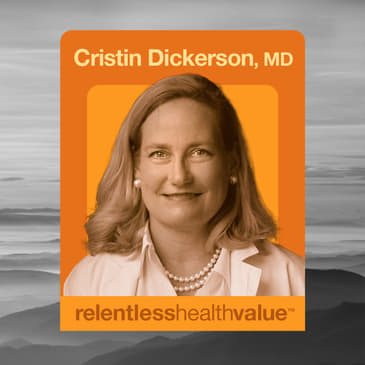
My guest today, Cristin Dickerson, MD, as I have mentioned several times, is the founding partner of Green Imaging, a physician-led radiology network, pioneering affordable, high-quality medical imaging for patients, employers, and health plans nationwide.
Green Imaging (round of applause now) has grown to be an $18-million company. Love it when you hear a doing well by doing good story.
I also very much appreciated Dr. Dickerson offered a very, very lovely donation to support the work of this podcast. Thank you to her and Green Imaging for this.
This podcast is sponsored by Aventria Health Group and also Green Imaging. If you’re a plan sponsor, please give them a call.
Also mentioned in this episode are Green Imaging; Elizabeth Mitchell; Purchaser Business Group on Health (PBGH); Al Lewis; John Lee, MD; Jonathan Baran; Brennan Bilberry; Vivian Ho, PhD; Kimberly Carleson; Dave Chase; Keith Passwater; Havarti Risk; Andrea Cockrell; Houston Business Coalition on Health (HBCH); Peter Hayes; Anthony Ciaccia; Dawn Cornelis; Cynthia Fisher; Justin Leader; Cora Opsahl; Preston Alexander; Kurt Christie; Claire Brockbank; Andreas Mang; Chris Deacon; Stanley Schwartz, MD; and ZERO.health.
You can learn more at Green Imaging and follow Dr. Dickerson on LinkedIn.
Cristin A. Dickerson, MD, is the founding partner of Green Imaging. She is a graduate of the University of Texas (UT) Medical School at Houston, where she was elected to Alpha Omega Alpha Honor Medical Society. Dr. Dickerson completed her radiology residency at UT Houston, where she was a chief resident, with extensive training in cancer imaging at MD Anderson Cancer Center.
Dr. Dickerson practiced for 13 years at the Diagnostic Clinic of Houston, where she served as a two-term president of the 50-physician clinic and oversaw a self-funded health plan.
She founded Green Imaging in 2011 to provide affordable, high-quality medical imaging for uninsured and high-deductible patients in Houston and rapidly expanded the company to provide services throughout most of the United States and to employer-sponsored health plans. She loves being able to provide quality services to patients who otherwise couldn’t afford them and delivering significant imaging cost savings to patients with healthcare coverage and their employers without compromising quality.
09:52 Who has figured out that direct contract imaging is a great avenue to saving money?
12:39 What are the barriers to getting started with direct contracting imaging?
15:33 EP480 with Kimberly Carleson.
15:36 EP285 with Dawn Cornelis.
16:45 EP457 with Cynthia Fisher.
17:39 EP433 with Justin Leader.
18:12 What do you do when TPAs become a barrier to direct contracting?
20:47 Why going through a TPA actually makes direct contracting more complicated.
22:16 EP482 with Preston Alexander.
25:01 Instagram video on insured rate versus cash rate.
25:26 EP425 with Marshall Allen.
25:52 EP453 with Claire Brockbank.
26:02 EP419 with Andreas Mang.
26:29 How is the “down the hall” mentality a barrier to direct contracting?
31:25 EP395 with Brennan Bilberry.
32:25 Why is it important to change member behavior?
Recent past interviews:
Click a guest’s name for their latest RHV episode!
Elizabeth Mitchell (Take Two: EP436), Dave Chase, Jonathan Baran (Part 2), Jonathan Baran (Part 1), Jonathan Baran (Bonus Episode), Dr Stan Schwartz (Summer Shorts), Preston Alexander, Dr Tom X Lee (Take Two: EP445), Dr Tom X Lee (Bonus Episode), Dr Benjamin Schwartz, Dr John Lee (Take Two: EP438), Kimberly Carleson
00:00:00
Stacey Richter: Episode 485.
00:00:03
"Imaging Costs Six to 11% of Plan Sponsor Spend. How Direct Contracting
00:00:09
Can Save Money and Improve Access." Today I speak with Dr. Cristin Dickerson.
00:00:22
American Healthcare Entrepreneurs and Executives You Want to Know, Talking.
00:00:29
Relentlessly Seeking Value.
00:00:31
Welcome, Relentless Health Value listeners.
00:00:34
Today on the show, we're talking direct contracting for imaging.
00:00:38
Imaging costs can be in the range of six to 11% of total plan sponsor
00:00:44
spend, and you can figure that out if you have the data to add up the
00:00:48
imaging charges themselves, plus contrast charges, plus professional
00:00:52
services, facility fees, et cetera.
00:00:54
But let me ask you this, why would anybody direct contract
00:00:57
for services such as imaging?
00:00:59
This, why bother despite the significant cost is not some kind of rhetorical
00:01:04
question, by the way, even though to longtime listeners it might feel like it.
00:01:08
And to make this even more rhetorical, let's just forget about TPAs for the
00:01:13
moment and disregard what Elizabeth Mitchell, CEO of PBGH said to me about
00:01:18
some of them who may or may not be skimming 30% off the top of plan spend.
00:01:22
Let's just forget about that now and just discuss one other foundational
00:01:26
point that has to be locked in to justify why direct contracting is a solution.
00:01:32
Are there actually cost differences between different clinical organizations
00:01:36
or quality differences for that matter?
00:01:39
Is that true?
00:01:40
Is that the case?
00:01:41
Do cost differences exist?
00:01:43
Lemme tell you about this, I'm gonna say pretty upsetting, but also pretty
00:01:46
revealing conversation I had the other day with a friend of mine.
00:01:51
Someone who is a professor at a top university.
00:01:55
So a smarty by any definition, but also a normal civilian.
00:02:00
Healthcare is not her day job as it is not mostly the day job of
00:02:05
many plan sponsors, people in HR.
00:02:08
So it came up, I swear I don't launch into healthcare industry diatribes
00:02:13
at random dinners with random people, or not that often, at least.
00:02:17
But anyway, healthcare costs came up and I found myself talking about all of the
00:02:22
stuff going on with New York Presbyterian.
00:02:25
That DOJ investigation had dropped earlier that day.
00:02:29
And also they have a hospital up the street from actually
00:02:32
where we were having dinner.
00:02:33
Now recall that part of that DOJ investigation, and there's a couple of
00:02:38
class action lawsuits afoot, but part of that whole thing what is being alleged
00:02:42
is Presy charging way more for knee replacements and colonoscopies, et cetera.
00:02:48
Like charges double or sometimes three times as much as other local
00:02:52
hospitals or ASCs, with the same quality . And my friend, she bursts out.
00:02:57
Come on.
00:02:59
She says this really aggressively, actually, like she's saving
00:03:03
me from a conspiracy theory.
00:03:04
She says it is not possible that one hospital would be able to
00:03:08
charge that much and others so much less the market would even it out.
00:03:12
No one would go to the expensive place.
00:03:14
In that moment, I took off my tinfoil had and laid it gently by my side.
00:03:19
No, my heart broke.
00:03:20
Let me tell you.
00:03:21
Just that morning, I had been helping a friend of the family whose kid got cancer
00:03:25
and I was helping them not lose their house to majorly inflated medical bills.
00:03:28
These are the people who are harmed by anti-competitive contracts,
00:03:33
by plan sponsors getting trapped into discount based contracts with
00:03:36
conspicuously missing net prices.
00:03:39
This is not a no harm, no foul arrangement from any given patient's
00:03:44
point of view, what is being alleged in that DOJ investigation.
00:03:48
So I've been ruminating over the why here, as in why this person and others
00:03:51
indubitably like her, why are they so aggressively opposed to reality?
00:03:57
Is it just that it, does actually sound illogical on its face
00:04:02
because Yeah, it kind of does.
00:04:04
Or for sure it could be the age old story that those who are
00:04:07
healthy and well resourced enough are well and truly insulated.
00:04:12
They aren't sick and they have good enough insurance at least
00:04:15
so far, and enough in their bank account to cover their deductible.
00:04:19
But I don't know.
00:04:19
I'm still reflecting.
00:04:20
I'm confident that many of you have encountered similar situations.
00:04:24
What did you do?
00:04:26
But I will tell you one thing that I am very sure about.
00:04:29
It was in that moment that I appreciated you Relentless Health Value listeners
00:04:33
and all of you who have spent the time and the energy and came face to face
00:04:38
with these really unappealing realities.
00:04:42
You have followed the dollar as it travels through this labyrinth
00:04:45
that is a feature, not a bug.
00:04:47
Because you all know the folks who are struggling to meet rent and at the same
00:04:51
time paying their share of $5 MRIs when down the street there's just as
00:04:56
high quality imaging for 300 or 500.
00:04:59
And as we all know, it's anti-competitive contracts that often prevent
00:05:02
those of us who do get it to steer and tier and educate members.
00:05:06
And this is why the show today about direct contracting is so important
00:05:11
because direct contracting can help make sure that members get a fair price.
00:05:16
Okay, I'm back on track now.
00:05:17
Sorry, it's been a rough week.
00:05:18
My conversation today with the one and only Dr. Cristin Dickerson delves into the
00:05:23
merits of direct contracting for imaging and the conversation emphasizes the
00:05:28
significant savings that this can offer.
00:05:31
Given that imaging, again, constitutes 6% to as much as 11% of
00:05:37
plan sponsor healthcare spending.
00:05:39
What I think is interesting, slight sidebar here is, you know, Al Lewis
00:05:44
talks about in that episode how ER spend has crept up to around 6% of your
00:05:50
average plan sponsor's total spend.
00:05:52
And I don't know, maybe it's just the 6% callback that maybe wants to say this.
00:05:56
But don't forget a big point that Al made in that ER show and that I underlined
00:06:01
in the ER through line episode that came right after that Al Lewis show.
00:06:05
And also this comes up in the pod with Dr. John Lee, who is an ER doc.
00:06:10
The more a plan sponsor tries to control imaging or diagnostic in general spend,
00:06:14
the more patients wind up going to the ER because either they realize or are told
00:06:20
that if they wanna just get to the bottom of what's going on with their bodies
00:06:23
without getting caught in prior auth rigamarole, they should just go to the ER.
00:06:28
So paradox and just another example of how, what could seem very logical on
00:06:33
its face, you know, control costs this way actually leads to higher costs.
00:06:39
Anyway, as you listen to the show that follows.
00:06:41
I also would think about what Jonathan Baran talked about in the Flywheel
00:06:45
Show from a few weeks ago, how a plan sponsor can save again, double
00:06:48
digits when they buy good healthcare as their prime directive, not buy
00:06:51
discounts or try to math their way into a solution that just adds even
00:06:56
more mystery and more middle people.
00:06:58
Direct contracting is certainly a way to think about that, and it is something
00:07:02
that certainly Jonathan Baran mentioned.
00:07:04
Shows to listen to or reflect upon adjacent to this one, Brennan Bilberry
00:07:08
about anti-competitive contracts, and there's also a Summer Short
00:07:11
about why they are so intractable.
00:07:13
Vivian Ho, talking about what drives up premiums.
00:07:16
Spoiler alert.
00:07:17
It's costs driven by big consolidated health systems.
00:07:20
We had Kimberly Carleson on recently echoing many of the themes you'll
00:07:23
hear in the conversation that follows.
00:07:26
Also the show with Dave Chase talking about figuring out
00:07:28
whether your TPA and or benefit consultant is truly working for you.
00:07:32
Wow, that matters.
00:07:35
Keith Passwater: Hi, I am Keith Passwater, CEO of Havarti Risk.
00:07:37
As a healthcare actuary, I can sometimes get deep into the weeds
00:07:40
of the math behind healthcare.
00:07:41
Maybe you experience that as well, getting hyper-focused
00:07:44
to your corner of healthcare.
00:07:45
That's why I so appreciate Relentless Health Value.
00:07:48
Listening to the conversations reminds me that our healthcare system is huge, but
00:07:52
we're ultimately here for the patients.
00:07:54
If you wanna make a difference in healthcare, don't miss an episode
00:07:57
of Relentless Health Value, and I really encourage you to follow the
00:07:59
podcast on Apple Podcast or Spotify.
00:08:02
And please leave a review.
00:08:03
Thanks for listening.
00:08:05
Stacey Richter: My guest today, Cristin Dickerson, MD, as I have mentioned
00:08:09
several times, is the founding partner of Green Imaging, a physician-led radiology
00:08:14
network, pioneering affordable, high quality medical imaging for patients,
00:08:18
employers, and health plans nationwide.
00:08:20
Green imaging round of applause now has grown to be an $18 million company.
00:08:25
Love it when you hear a doing well by doing good story.
00:08:28
I also very much appreciated, Dr. Dickerson offered a very,
00:08:32
very lovely donation to support the work of this podcast.
00:08:35
Thank you to her and Green Imaging for this.
00:08:39
My name is Stacey Richter, and this podcast is sponsored by Aventria
00:08:42
Health Group and also Green Imaging.
00:08:44
If you're a plan sponsor, please give them a call.
00:08:46
And with that here is my conversation with Dr. Dickerson.
00:08:49
Dr. Cristin Dickerson, welcome to Relentless Health Value.
00:08:52
Cristin Dickerson: Happy to be here.
00:08:53
Excited.
00:08:53
Stacey Richter: Imaging, six to 11% I think, of plan, sponsor
00:08:57
spend, going to imaging.
00:08:59
Multiple experts have said that if you want to start doing direct
00:09:03
contracting, start with imaging, and I think we can start to see why, just
00:09:07
by the magnitude of those numbers.
00:09:09
But also it's got less friction for a bunch of reasons, like patients aren't
00:09:13
really loyal usually to an imaging center.
00:09:16
So, Dr. Cristen Dickerson, let me ask you this.
00:09:19
Who has figured this out right now as far as plan sponsors go?
00:09:23
Is it mainly very innovative, employers or TPAs.
00:09:27
Cristin Dickerson: We're seeing larger employers move this direction.
00:09:29
We're moving upstream in the employer market.
00:09:32
I would say a year and a half ago, our average client was in the 300, 400 range.
00:09:38
Now it's in the 3000, 4.
00:09:40
When I spoke with the head of the health plan at City of Plano, Andrea
00:09:45
Cockrell on a panel at the Houston Business Coalition on Health.
00:09:50
She said she brought in Green Imaging to solve a cost problem, but what she
00:09:53
found was there was an access problem.
00:09:55
What she was really solving was an access problem for two reasons.
00:09:59
Number one, it's hard to find some of these new exams, some of these myocardial
00:10:03
MRIs, and you know, only in a handful of facilities even in Houston offer this.
00:10:07
You know, we're kind of the heart capital of the world.
00:10:10
And also that people couldn't afford it.
00:10:12
62% of Texans are not getting care or delaying care because they can't afford
00:10:18
it, and so that you're able to get them the care they need when they need it, not
00:10:23
delaying things so it's more expensive and they miss more work down the line.
00:10:27
And the employer still saves money.
00:10:30
Stacey Richter: You said a couple of things.
00:10:31
One of them is, you know, I kind of asked you is this, arcane
00:10:35
solution that only a few are using?
00:10:37
And you said no.
00:10:38
This is becoming more of a mainstream kind of thing.
00:10:41
And you can start to see why.
00:10:43
It was really interesting what you said that, you know, an employer can
00:10:46
do a 0% copay, like no cost sharing with the employee and still save money.
00:10:52
If someone's spending 6%, 11% of total spend, there's a lot
00:10:56
of opportunity for savings.
00:10:58
If we can save the money and, and improve access, that seems like a win-win.
00:11:02
Cristin Dickerson: That ethical alignment also helps with the market momentum,
00:11:07
and I think we're getting that across the board in the ecosystem or tribe.
00:11:11
Stacey Richter: We, we talked about the why now we, we've talked about the
00:11:14
reasons and some of its costs, some of it's quality, some of it's access,
00:11:19
member experience, member perception.
00:11:21
I mean, anybody that needs imaging like there's a problem.
00:11:23
It's like, here's a way that our members who are in pain or scared
00:11:29
are able to get what they need.
00:11:32
Cristin Dickerson: Even getting a mammogram is, as we all know, I mean
00:11:34
best day of the year is when you get your negative mammogram report.
00:11:38
So that, you know, that's really what I talk about with my scheduling staff
00:11:41
is everybody who comes to you is going to be under healthcare stress
00:11:47
and people behave differently when they're under healthcare stress.
00:11:50
Stacey Richter: Let's talk about the barriers now, right?
00:11:52
So, and, and mostly thinking about this from the standpoint of a plan sponsor who
00:11:57
is thinking to themselves, I would like to do something here, but they're maybe
00:12:03
at the very beginning of their journey.
00:12:06
Let's just start here.
00:12:06
The first barrier that I am understanding as you're talking is probably just
00:12:10
the complexity of the situation.
00:12:13
Because where there's mystery is margin, as Anthony Ciccia coined
00:12:19
that phrase, and wow, it is so true because it enables margin to be hidden.
00:12:24
Some of the complexity from just listening to you talk here, I have a
00:12:28
feeling has to do with how services are being coded dollars that are kind of
00:12:36
lost or they're put in other buckets so they sort of disappear into thin air.
00:12:40
Could you explain more?
00:12:42
Cristin Dickerson: Sure there are a lot of ways that happens.
00:12:44
I would say that one of the really interesting stories is school district
00:12:48
of Osceola County in Florida.
00:12:50
In 2019, the teacher union went to the school board and said, you
00:12:54
know, something's gotta give these school bus drivers, cafeteria
00:12:57
workers have a $5 deductible.
00:13:00
$6 maximum out of pocket.
00:13:02
They're functionally uninsured.
00:13:04
And so we did this claims data analysis and what we found was, yes, they
00:13:09
were paying excessively for imaging.
00:13:11
They had about, just on a CPT code by CPT code basis.
00:13:15
We were able to show about 60% savings.
00:13:19
But what also emerged from that was there's something
00:13:22
called a hospital revenue code.
00:13:24
And, um, with this carrier, it is supposed to be used only for inpatient,
00:13:29
but there were literally hundreds of imaging exams that were paid out at
00:13:34
thousands and thousands of dollars.
00:13:36
I think there was one CT scan that was paid out over $50 with hospital
00:13:41
revenue codes rather than CPT codes.
00:13:44
And so those were escaping the claims adjudication process because
00:13:48
they were a different type of code.
00:13:50
And that that's the perfect type example.
00:13:53
It's something that they never had eyes on.
00:13:55
Even if you did a CPT code analysis, you wouldn't see that.
00:13:59
And you know, that's where we see things like clawbacks.
00:14:02
That's where we see the multiple pre-auth charges.
00:14:05
That's where we see the alternative network charge that might, a lot
00:14:09
of times the RBP fees are higher than what was paid to the provider.
00:14:14
Just like with the MultiPlan situation again, where those fees that end up being
00:14:19
higher than what's actually paid out.
00:14:22
Stacey Richter: So we're talking about the first barrier to implementing
00:14:25
some kind of direct contracting for imaging, and I boldly said it was
00:14:31
probably complexity and now I'm boldly doubling down that I think I'm right.
00:14:36
The things that you're talking about here are deeply embedded in codes.
00:14:40
Like your average civilian looking at this stuff might not realize there's
00:14:43
these other hospital revenue codes that exist, or, you know, Kimberly
00:14:48
Carleson in that episode talked a lot about bundling and unbundling, right?
00:14:51
Like, so a scan is supposed to include all these eight codes,
00:14:57
that's all in the bundle.
00:14:58
And then the employer, how would you know this, right?
00:15:00
Like they'd get charged the bundled price and then four codes that are supposed
00:15:05
to be in the bundle kind of thing.
00:15:08
You're talking about, employers are getting
00:15:09
charged for the pre-auths or the prior auths as
00:15:12
Stacey Richter: a separate bucket of things, or the contrast is
00:15:16
someplace else or whatever.
00:15:18
If it sounds like a self-insured employer doesn't have a third party
00:15:22
payment integrity vendor looking at some of this stuff, all they're
00:15:26
going off of is what their ASO or somebody else is telling them.
00:15:31
There are so many perverse incentives for anybody who's in the middle
00:15:35
moving people's money around.
00:15:37
So many different ways dollars can be obscured so barrier one is just, I
00:15:44
think, the complexity and it sounds like the answer is, get someone who is an
00:15:49
unconflicted third party to do an audit, or it sounds like Green Imaging or you
00:15:55
know, other independent imaging centers can also do audits to at least get someone
00:16:02
started where the landmines might be.
00:16:04
Cristin Dickerson: It's eye-opening for employers to see what they're
00:16:07
really spending, and I would love to get my hands on their weekly file feeds
00:16:11
that most of them are auto-paying.
00:16:13
And really see what's in there.
00:16:15
Especially with some of these, especially the private equity backed TPAs.
00:16:19
I think my suspicion is there's a lot in there.
00:16:22
Stacey Richter: Listen to the podcast with Justin Leader called the
00:16:24
Mystery of the Weekly Claims Wire.
00:16:26
Cristin Dickerson: One of the major carriers right now is only
00:16:29
giving employers the plan payment or the member responsibility.
00:16:35
They won't give you both.
00:16:37
And so how on earth can you do fiduciary duty if you only know a part of
00:16:41
the cost of a CPT code or a bundle?
00:16:44
It makes no sense.
00:16:45
Stacey Richter: The show with Cora Opsahl
00:16:47
and there's also a show with Dave Chase where we dig into why it is so important
00:16:52
to get data and how to to get it.
00:16:54
The second barrier that I am hearing relative to moving in this
00:17:02
direction is when you hear that the TPA won't do imaging or other
00:17:08
direct contracting as a rule, or they blame benefit design somehow.
00:17:14
How do you think about that one?
00:17:16
You know, how does that transpire and then what do you do about it?
00:17:19
Cristin Dickerson: I really personally feel like a direct
00:17:21
contract shouldn't involve a TPA.
00:17:24
There are so many barriers that we run into with this.
00:17:27
I'm happy, you know, there are some great TPAs out there.
00:17:30
There are some that are working beautifully with us.
00:17:32
But there's a lot of resistance, and it's either because they really feel
00:17:36
challenged by their major carrier with whom they have an agreement.
00:17:41
There is a clause in that contract.
00:17:43
There's also a clause in that contract that says anything that's excluded
00:17:46
by law, you know, is not valid.
00:17:48
And so really that is referring to the HIPAA omnibus rule, which allows
00:17:53
individuals or somebody paying for on their behalf to withhold PHI from
00:17:59
the insurance company and pay cash.
00:18:02
Stacey Richter: What you're talking about is that, you know, a, a self-insured
00:18:05
employer plan sponsor goes to their ASO, TPA and says like, I wanna
00:18:09
do direct contracting for imaging.
00:18:10
And then TPA says, I can't do it because it violates our, insert
00:18:14
carrier name here, contract.
00:18:16
Which it really could.
00:18:18
Every time this topic comes up on the show, I hear from some
00:18:22
ASO or TPA who says, look, I am really beholden to my carriers.
00:18:26
Like there are certain things where I just, I simply can't do them.
00:18:29
So could you answer the question very specifically, if a TPA comes
00:18:34
and says, we can't do that because it's in violation of our carrier
00:18:37
contract, and the employer says, but I still want to, are we at an impasse?
00:18:43
Cristin Dickerson: We're not at all.
00:18:43
The employer doesn't have to involve the TPA at all.
00:18:47
I would say that our larger employer groups are going around the TPA, maybe 80%
00:18:52
of them because it's simpler and easier.
00:18:55
Stacey Richter: So if a TPA is just like, look, I got a carrier, I have
00:18:59
a longstanding relationship with this carrier, I've got a lot of
00:19:01
other business with this carrier.
00:19:04
So for you, your one group, I can't undermine my entire book of business
00:19:10
because you wanna do something.
00:19:13
The point that you're making is that you have plenty of
00:19:15
groups who are like, okay, fine.
00:19:16
You do you TPA, meanwhile I'm gonna do me.
00:19:19
And that is managing a direct contract with this imaging
00:19:24
center and maybe others as well.
00:19:26
And you don't need the TPA.
00:19:28
Cristin Dickerson: You don't need the TPA.
00:19:29
Stacey Richter: Does that get crazy?
00:19:30
Cristin Dickerson: And in fact, the TPA can complicate the situation.
00:19:33
Stacey Richter: Like so are you just, I mean, if you think about third party
00:19:36
administrator, they're doing a bunch of different things, but one of them
00:19:39
is sending the weekly claims wire.
00:19:41
So basically what you're saying is you just send a bill.
00:19:43
Cristin Dickerson: Oh, we just send a bill, but it has all the, the data that's
00:19:46
needed by stop-loss to provide decrements.
00:19:50
It has, you know, or it would be used in a stop-loss audit, has all the
00:19:54
information that is sent to a TPA.
00:19:56
Stacey Richter: And I guess you don't need repricing or anything like that.
00:19:58
Like one of the reasons why you'd go through a TPA is because they
00:20:01
have to do all the checking of the contracts and blah, blah, blah.
00:20:03
But if there's just, there is none of that, right?
00:20:06
It's just like, here's your price, you're gonna pay that.
00:20:08
Then this is a way, yeah.
00:20:10
Cristin Dickerson: And the other reason would be a pre-auth and you know, really
00:20:12
pre-auths don't change utilization.
00:20:15
And what we do is we do radiologist protocols, which are much more specific.
00:20:19
That comes down to is contrast really needed.
00:20:22
CTs of the chest are ordered 30% of the time with and without,
00:20:24
with contrast, and it either needs to be done with or without.
00:20:27
And so we cut the radiation in half, often decrease the
00:20:31
contrast risk and cut the cost.
00:20:32
Stacey Richter: You just said something interesting there.
00:20:34
You said that, you know, one of the, uh, TPAs job is to manage radiology
00:20:39
prior auths, but prior auths don't actually reduce the number of images.
00:20:44
Is that substantiated by anything or is that in your experience?
00:20:47
Cristin Dickerson: The American College of Radiology Um, did a study a couple
00:20:50
of years ago that showed that, that they do nothing except delay care.
00:20:54
Stacey Richter: Yeah.
00:20:54
I, you know, I've heard, I think it was Al Lewis was talking about that, about this
00:20:57
at one point, and we just did a show with Preston Alexander talking about the float.
00:21:01
So, it is in any given carrier's interest here to delay care as long as possible.
00:21:08
And there is, I've seen, I'm not necessarily thinking of any given study
00:21:14
per se, but I've heard anecdotally quite a bit that prior auths will
00:21:19
push imaging to the next quarter.
00:21:22
So like if someone says, well, how many images were prevented this quarter?
00:21:26
There's always a really big number there that probably somebody can trot out.
00:21:30
But then if you look at how many of those people got images at some
00:21:35
point in the future, it is a higher number than you would expect if
00:21:41
inappropriate care was being prevented.
00:21:44
Cristin Dickerson: Absolutely.
00:21:45
It also depends on the fair cost of what you're doing.
00:21:48
If you've got an MRI that costs $400, how is delaying care for six weeks
00:21:53
of physical therapy, which is gonna cost a lot more than that, that may
00:21:57
be delaying surgery for somebody.
00:21:59
It may, you know, be making things worse.
00:22:01
How does that make financial sense?
00:22:03
If you've got a fair price upfront.
00:22:05
Stacey Richter: That's say another really, like if it costs $50, all right.
00:22:10
You can start to see why there's a good reason.
00:22:14
You know, you prevent one inappropriate case, you wound up saving enough
00:22:18
to pay for a lot of prior authing.
00:22:20
However, if you're doing something that costs $400, like the administrative
00:22:25
cost could wind up being, assuming there's no patient harm, that winds
00:22:28
up transpiring, but you kind of get into the zone where you wind up with
00:22:33
administrative burden and how much is going on, and how many do you have to
00:22:37
prevent in order to make it worth it.
00:22:40
Cristin Dickerson: 90 something percent of doctors know a patient who
00:22:43
has been harmed or died because of pre-auth delays related to pre-auth.
00:22:48
Stacey Richter: So, okay, second barrier that we're talking about
00:22:50
here, and we expanded our circle of what we were talking about, but we
00:22:53
started out as the second barrier, as TPAs won't do it as a rule, or
00:22:57
they blame benefit design somehow.
00:22:59
And I think what we have come up against here is that a lot of
00:23:03
times TPAs actually can do it.
00:23:05
It's just complicated, and they may not want to, or they may
00:23:08
have some perverse incentives.
00:23:10
Other times they really can't because they do have a carrier contract,
00:23:14
which is gonna prevent them.
00:23:15
But if you're a self-insured employer and you're thinking to yourself,
00:23:18
but I still really wanna do that, then don't go through the TPA.
00:23:21
There's plenty of precedent for doing a direct contract.
00:23:24
Not through a TPA.
00:23:26
Cristin Dickerson: And they may have their own vendors that they're making money.
00:23:29
They may have an RBP plan that they feel like it competes with.
00:23:32
They may have another vendor that's paying referral fees to them.
00:23:37
So there are additional reasons that they don't wanna do it,
00:23:40
that maybe, um, not as apparent.
00:23:42
Stacey Richter: Let me also just remind everybody that we've had guests after
00:23:46
guests on this podcast basically say that if a plan sponsor goes to their
00:23:50
EBC or their TPA and says, Hey, I wanna do this because it's better for
00:23:55
me and my members and they wind up with like a 72 page, very complicated
00:24:00
report about why they can't do it.
00:24:02
If the disruption, the D word, as Claire Brockbank calls, it gets trotted out.
00:24:06
If any of those things happen, that's a red flag that there's
00:24:10
probably money being made somewhere.
00:24:12
Andreas Mang, in the first episode with him, he said this really crisply.
00:24:15
He's like, you don't need a 5500 disclosure form sometimes to tell if
00:24:19
somebody's taking money in indirect payments by the reaction when you
00:24:23
ask very specific information or you wanna try to do something innovative.
00:24:27
You can tell whether they're working with you and trying to figure out how
00:24:31
to do it, or they're giving you 900 reasons why you simply can't because
00:24:36
it's gonna disrupt their income stream.
00:24:38
Okay, so third barrier this down the hall mentality.
00:24:41
There's probably a, a couple of things there.
00:24:43
One of them, it's, it's easier to walk down the hall, but secondly the doctor's
00:24:46
like, but I need the full report.
00:24:48
And if you go someplace else, I'm not gonna get the report.
00:24:50
Cristin Dickerson: There is some legitimate worry when there prior studies.
00:24:53
We've invested heavily in the image sharing options that are out there.
00:24:57
It's still not ubiquitous that you can push around images from system
00:25:01
to system, but there are a number of companies that are making that easier,
00:25:04
and we've invested heavily in that for that reason, because we do know good
00:25:08
doctors wanna see the images themselves, especially the subspecialist surgeons.
00:25:12
They need to see the images.
00:25:14
But what I'm finding is there's less and less pushback.
00:25:17
As the cost has risen, and so few people are actually getting the imaging
00:25:21
that their doctor's recommending when they say, I have a zero out-of-pocket
00:25:25
option that's being honored more often, uh, with, with very little pushback.
00:25:30
So really, I think doctors don't know how expensive it is often down the hall, and
00:25:35
I think they would be more sympathetic if they actually knew how much it was.
00:25:39
I bet you 60% of doctors can't even come close to telling you what
00:25:43
that imaging costs down the hall.
00:25:45
And you know, I think patients don't and they get horrifically high bills now.
00:25:50
I would've thought an ultrasound down the hall at the hospital
00:25:53
would've been affordable these days.
00:25:54
I just had a claims data set that came in at $1 for the average ultrasound.
00:25:59
You know, that's rebundled.
00:26:00
Stacey Richter: So if we're thinking about the down the hall as a barrier,
00:26:05
one of the things you are saying, as patients become more aware, and as
00:26:09
the bills become higher, that fear may outweigh the opportunity for convenience.
00:26:17
The fear of having a gigantic unknown charge.
00:26:22
The second thing, the patient's worried that their doctor won't get the imaging.
00:26:26
And if you're working with a place such as Green Imaging or you're
00:26:31
working with a place that has invested a lot in image sharing, which like
00:26:34
if you're an independent radiology center, in a way, you better.
00:26:38
Because all the images are gonna need to get shared, and if you
00:26:41
don't do it really well for the originating physician, then I mean,
00:26:46
what are, what are we even doing here?
00:26:48
Cristin Dickerson: Or at least we make it seem seamless.
00:26:51
Stacey Richter: Part of the skill is making it look easy.
00:26:53
We talked about three barriers here, and also in the context of
00:26:56
talking about those barriers, we talked about ways to overcome them.
00:26:59
The first barrier we talked about is just the complexity that there's
00:27:03
just so much self-interested behavior right now and some complexity a lot
00:27:08
of times, sure this is complicated.
00:27:11
But if you want to overcome it, there's certainly unconflicted payment integrity
00:27:16
vendors, unconflicted benefits advisors.
00:27:19
There's plenty of people who can really dig in or learning from
00:27:22
somebody else's experience, right?
00:27:24
Like if you hear that an employer in your area did the math and figured
00:27:28
something out, that there's probably a likelihood that as a similar
00:27:33
plan sponsor, probably you've got a similar circumstance, I would say.
00:27:38
Cristin Dickerson: Yeah, and you know, we have reams of claims data.
00:27:40
I have claims data from all the major carriers, most independent
00:27:44
TPAs in different industries, different geographic areas.
00:27:48
All of those things make a difference.
00:27:50
But we have thousands of claims data assessments, so I can usually match one
00:27:54
to an employer and say, Hey, this is what we would typically see in that setting.
00:27:58
Even RBP, we can show them RBP claims data sets, where we've got,
00:28:02
we actually have those fees and we can show what they're paying in the
00:28:05
background compared to Green Imaging.
00:28:07
The other thing, and I feel like this is where this trust factor comes in too.
00:28:11
It is that there's no risk with us with out competitors often have a PE PM.
00:28:16
I strongly feel that being fee for service aligns me ethically with the employer
00:28:22
because there's no risk to the employer.
00:28:24
If their members don't use us, , we're not gonna get paid.
00:28:27
So they can go into the first quarter, their members can use us.
00:28:31
We can compare that to what they were paying before or compare it
00:28:34
to market prices, some published entity, Turquoise, whatever it is.
00:28:38
Use that as the baseline and show them the savings.
00:28:43
And so I, and we do that ongoing with our employers and I really feel like
00:28:47
that's how you build the trust factor.
00:28:49
Stacey Richter: That is probably a way for plan sponsors to feel like
00:28:52
they've gotten the best answer that they possibly can, and what is really
00:28:55
a gray, murky world where there is lots of money getting moved around.
00:29:00
Cristin Dickerson: It's actually kind of amusing right now, some
00:29:02
of the clauses that people want us to put in our agreement.
00:29:06
You know, we're not, we're not a traditional carrier.
00:29:08
We are somebody who's been trusted in the market.
00:29:11
And look, this is our promise.
00:29:12
Everything's in our bundle.
00:29:14
It's all in there, and you're not gonna have to pay anything else,
00:29:17
and it's gonna save you money.
00:29:18
Stacey Richter: Yeah, keep it simple.
00:29:19
The second barrier that we talked about is the whole TPAs won't do this,
00:29:24
or it's conflicts with benefit design somehow, which again, is a thing.
00:29:29
Chris Deacon just wrote a post about this.
00:29:32
There's a lot of third party deal making.
00:29:35
Had a show with Brennan Bilberry about anti-competitive
00:29:37
contracts very specifically.
00:29:39
There's just so many things that are going on, which could prevent someone
00:29:42
from doing something, which in fact is in their clients best interest and in
00:29:47
those circumstances, we talked about a couple of different workarounds there.
00:29:51
One of them is just being very demanding because sometimes if where there's
00:29:56
a will, there's a way, but if not, hopefully, let's just say the plan sponsor
00:30:00
didn't sign the rights away here, but there are opportunities to do direct
00:30:04
contracting, not through a TPA who is not able to do it or doesn't want to.
00:30:10
Either way, it doesn't matter.
00:30:11
You can do it yourself.
00:30:12
And then the third is kind of curbing the down the hall mentality.
00:30:17
And one of the things that you implied in that last answer is that you take
00:30:21
it upon yourself over at Green Imaging, and I would assume that anybody
00:30:25
else in this, the direct contracting business, we're, we're gonna have
00:30:28
Stanley Schwartz from Zero Health, who does direct contracting more on
00:30:31
a broader scale, talk about this too.
00:30:33
And both of you are saying the same thing, that it's our responsibility to
00:30:36
figure out how we are talking to members.
00:30:38
Teaching members.
00:30:39
Changing member behavior so that they don't do the down the hall thing.
00:30:43
And obviously you've got a ton of experience doing that
00:30:46
that you can bring to bear.
00:30:47
So members take advantage of this cost, access, you know, all the good things.
00:30:51
It's a win-win.
00:30:52
Cristin Dickerson: Yeah, and I think that's where the
00:30:53
member experience comes in.
00:30:54
I really built this company thinking price transparency was gonna level the market
00:30:59
and we just had to be the best from a customer service and quality standpoint.
00:31:03
And, and so that's been my mentality all along.
00:31:06
Certainly on the pricing, we have not seen that and the gap has remained, but
00:31:12
I think if people look at our Google reviews, they'll see just how easy we
00:31:16
make it for people and how much of the hassle factor we take off their plates.
00:31:21
Which is I really think if you can make it seem easy to members, you get
00:31:26
that traction with an employer group and you get that water cooler talk
00:31:30
and it, it really starts working.
00:31:32
Stacey Richter: Which benefits plan sponsors.
00:31:34
Do you wanna talk a little bit about Green Imaging and where someone
00:31:37
can find out more information?
00:31:38
Cristin Dickerson: Sure.
00:31:39
Our website's a great resource.
00:31:40
Lots of videos, lots of links to articles.
00:31:43
www.greenimaging.net.
00:31:45
If you ever have a radiologist question, there's also an email link there to ask
00:31:48
us clinical questions if you need that.
00:31:51
You can request pricing there.
00:31:52
We will give over web chat over the phone, however you wanna request it.
00:31:56
We'll give you a quote.
00:31:57
Um, and it's all in.
00:31:58
Stacey Richter: If I am a plan sponsor almost anywhere in the United
00:32:01
States, you have enough facilities to have network adequacy in my area.
00:32:06
Cristin Dickerson: We do.
00:32:06
We can do a geo access, we can build out the network where we need to.
00:32:10
We also create bundles.
00:32:11
If we, if there's a pediatric sedation MRI that's needed, we can go, we
00:32:16
know , who we need to negotiate with, the anesthesia group, the radiology
00:32:20
group, and the facility, and create that bundle on behalf of an employer.
00:32:23
So yes, we're covering the country.
00:32:26
Stacey Richter: If there is a plan sponsor listening, who's thinking to themselves
00:32:29
six to 11% of spend, Hmm, maybe I should look into this, a good first step might
00:32:34
be just give you a call and you'll let 'em know what might be possible.
00:32:38
Or not really, but it might be a good first step to try to figure out what
00:32:42
a potential path forward could be.
00:32:44
Cristin Dickerson: You got it.
00:32:45
Stacey Richter: Dr. Cristin Dickerson, thank you so much for being on
00:32:48
Relentless Health Value today.
00:32:50
Cristin Dickerson: Always great to have a conversation with you.
00:32:52
Dr. Vivian Ho: Hi, I am Dr. Vivian Ho.
00:32:54
I'm a health economist at Rice University in Baylor College of Medicine.
00:32:58
I listen to Relentless Health Value religiously because this is the
00:33:02
show for those who are part of the tribe that wants to improve the
00:33:07
quality of healthcare, improve access to care, and make it affordable.
00:33:11
So make sure that you subscribe to the newsletter and subscribe to the
00:33:15
podcast and keep up with every episode.