
Last week, I announced I was on a tear to really get to the bottom of no margin, no mission. How do we, in real life, operationalize these very sort of inspirational but kind of vague words?
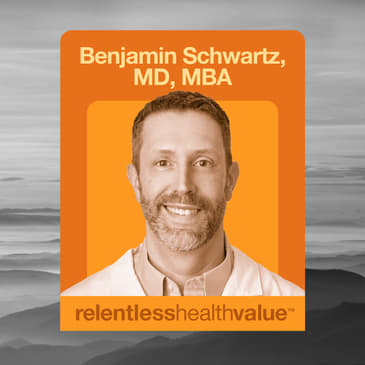
This conversation is largely me grilling Dr. Ben Schwartz on what no margin, no mission means to him, and how do you systematically pull it off? So, yeah, real softball kind of question. I’m joking, which is why I could not have been more appreciative of Dr. Ben Schwartz for taking on this challenge and coming back on Relentless Health Value to discuss.
For a full transcript of this episode, click here.
If you enjoy this podcast, be sure to subscribe to the free weekly newsletter to be a member of the Relentless Tribe.
Because here’s the thing: If you wanna do a start-up or you wanna do something in healthcare involving mission and margin, it is (but not always) a trade-off. It is often at least conceived that the more mission, the less margin. This trade-off is more likely, actually, going to be true and is often true when there are perverse incentives, such as stuff like the sicker the population is, the more money everybody makes.
From provider organizations to carriers to PBMs (pharmacy benefit managers) and, yeah, pharma to even brokers, consultants who are often paid a percentage of “shared savings” or get a little kicker for every prescription written, like, how common apparently it is for some big PBMs to pay employee benefit consultants for every single script that gets written—something like, what, $7, hypothetically.
But back to shared savings. You know, never forget shared savings go up when trend goes up. Rebates go up when list prices go up. This is always true.
And so, mission and margin only travel together if someone is creative, innovative, knowledgeable, dedicated, and has enough energy to force these two terms to align amidst a whole lot of countervailing industry norms, policies, shareholder fiduciary interests, and just some deeply ingrained culture.
I really liked how Anthony Stanowski put it in a recent Modern Healthcare article he wrote: “We often hear the phrase, ‘No margin, no mission.’ And it’s true—a system without financial viability cannot sustain itself. But the reverse is also true: Without mission, margin devolves into a utilitarian calculation of which procedures yield the highest returns, which drugs deliver the most measurable ‘value,’ or which population segment is most important to attract.”
So, with all that said, here’s what I’m up to, listeners. This is going to be a series where we talk about achieving mission success and if and/or how mission can fit into any given business model. Especially business models that we talk so often about on this podcast, which (from a mission standpoint, at least) could be labeled as bad, not so good, not so good for keeping patients (or people who really don’t want to become patients) healthy.
So, what I’m gonna do periodically is invite guests to come on Relentless Health Value to have this conversation with me. This started with the show last week with John Lee, MD (Take Two: EP438). I really wanna pick a few of your big brains about what it takes to run a healthcare practice or a business that is actually in that sweet spot, in the zone where mission and margin are balanced.
How can we get ourselves so situated as a business or as an industry or an ecosystem so that those who are able to balance mission and margin come out as winners? That is my goal.
Okay, I wanna talk about a complication now, a complication that is even more deep rooted than the whole perverse incentives thing. What’s even below that? Because why is it—you know, that Charlie Munger quote, Warren Buffett’s partner, who famously said, “Show me an incentive, and I’ll show you an outcome”—why is that even true in the first place? It’s not like, if there’s an incentive, then I must act in accordance to that incentive. Where does this come from, that if there’s a perverse incentive that the outcomes then are also perverse?
And this might be TMI philosophical, but yeah, here we are. So, let’s just go there for 45 seconds, why don’t we?
So, it’s important, I think, to recognize that monetary success is the bedrock of a lot of people’s self-esteem. I just listened to Scott Galloway, who’s an interesting cat. He has a podcast. He’s got several podcasts. And one of them, he went on at some length about how we so often measure, again, our self-worth by our literal worth. Like, every dollar we put in our pocket is like a quantitative increase in our value as a human being. And Scott Galloway continues, few people, even billionaires, feel they have enough money.
And again, I’m getting probably TMI philosophical here, but this thought really stuck with me. And I’ve been thinking about it for a week, just in terms of what this means for healthcare in this country. You know, if our basic value system is tied to increasing our net worth—and we often think that’s okay, even if it comes at the expense of personal relationships or our own health but also if the business is a healthcare business—me self-enriching in profiteering ways will negatively impact other people’s health.
But margin has become a cultural norm—the shoving of margin forward that mission just does not have, especially at the corporate level, 10,000 feet from any bedside of any patient. And I’m saying this with some emphasis. Of course, there is the Hippocratic Oath, for sure. But as far as laws go, the only maybe structural or legal framework around mission that I could find anyway is fiduciary responsibility.
And you know the only entity with fiduciary responsibility to patients or members? Plan sponsors, right? No, the boards of nonprofit health systems don’t have fiduciary responsibility to patients. Not TPAs (third-party administrators) or ASO (administrative services only) leaders as far as most courts seem to have determined so far. Not PBMs. None of these entities has any legal obligation to patients, members, or the communities they serve.
Dave Karlander was talking about this recently. Any health system or any of them talking about fiduciary responsibility, legally what that means is a responsibility to margin it up, for better or for worse, even as a nonprofit.
Alright, massive spoiler alert: So, if you don’t wanna hear this, skip ahead. But I just need to give you a heads-up of my big “holy smokes, blew my brain” moment of reckoning that cropped up in this conversation with Dr. Ben Schwartz. And it became so clear toward the end.
Where this conversation winds up is we circle the whole way back from whence we came: trust. That if you want to trust that no mission, no margin is gonna wind up a trade-off situation, like in a place that you can trust, then you have to trust the person who is making that call. So, it all comes back to trust.
So do listen to this episode, even though I just ruined the suspense. But, hey … that’s what I do.
And with that, here’s my conversation with Dr. Ben Schwartz. Also, read his bio on the Web site. He just got a brand-new job at Commons Clinic, so congratulations, Dr. Schwartz. His new job is not being an orthopedic surgeon full-time. He will be SVP, Care Services and Strategy, over there at Commons Clinic.
Also mentioned in this episode are Anthony Stanowski; John Lee, MD; Scott Galloway; Dave Karlander; Keith Passwater; Havarti Risk; Commons Clinic; Yashaswini Singh, PhD; Beau Raymond, MD; Rishi Wadhera, MD, MPP; Doug Geinzer; Scott Conard, MD; Andreas Mang; Peter Hayes; and Matt McQuide.
Related episodes: INBW42 with Stacey Richter; EP477 with Stacey Richter; EP474 with Yashaswini Singh, PhD; EP326 with Rishi Wadhera, MD, MPP; EP391 with Scott Conard, MD; EP419 with Andreas Mang; EP475 with Peter Hayes
You can follow Dr. Schwartz on LinkedIn and read his blog on Substack.
Benjamin J. Schwartz, MD, MBA, is a physician executive and fellowship-trained orthopedic surgeon with nearly two decades of experience in musculoskeletal care. After 17 years in clinical practice—including leadership roles in a private equity–backed MSO—he’s now transitioning from the operating room to executive leadership, focused on building scalable, patient-centered specialty care models.
Ben recently accepted the role of senior vice president of care services and strategy at Commons Clinic, a tech-enabled, value-based specialty care platform backed by leading healthcare investors. In this role, he will help shape the company’s clinical strategy, care delivery infrastructure, and multisite growth initiatives. He officially begins this position in fall 2025 and is currently supporting Commons in a consulting capacity.
Ben serves as chair of the Practice Management Committee for the American Association of Hip and Knee Surgeons and has advised multiple early-stage health tech start-ups. He is widely known for bridging the gap between frontline clinical practice and system-level innovation.
His writing appears in The Surgeon’s Record, where he explores the intersection of healthcare delivery, business strategy, and physician leadership.
Ben is passionate about reimagining musculoskeletal care through thoughtful integration of technology, operational excellence, and a renewed focus on the doctor-patient relationship.
08:50 Sister Irene Kraus and the origin of no margin, no mission.
10:01 Margin and mission versus profit and profiteering.
12:45 Stacey’s manifesto (EP400).
13:01 What is the broad mission within healthcare?
14:12 What is mission drift within healthcare?
15:54 EP474 with Yashaswini Singh, PhD.
17:26 Why do we struggle with balancing margin and mission?
20:47 EP455 with Beau Raymond, MD.
20:52 How does value vary?
23:18 EP326 with Rishi Wadhera, MD, MPP.
23:53 What needs to happen to balance margin with mission?
28:29 Why does everything come down to trust?
28:33 EP391 with Scott Conard, MD.
30:30 EP419 with Andreas Mang.
32:21 What are the “vectors of change” to create balance between mission and margin?
Recent past interviews:
Click a guest’s name for their latest RHV episode!
Dr John Lee (Take Two: EP438), Kimberly Carleson, Ann Lewandowski (Summer Shorts), Andreas Mang and Jon Camire (EP479), Justin Leader (Take Two: EP433), Andreas Mang and Jon Camire (EP478), Stacey Richter (EP477), Charles Green (Bonus Episode), Ann Lewandowski, Peter Hayes, Yashaswini Singh
00:00:00
Episode 481.
00:00:02
"Seriously, IRL, What Does No Margin, No Mission Even Mean?" That is the
00:00:08
question I ask Dr. Ben Schwartz.
00:00:19
American Healthcare Entrepreneurs and Executives You Want to Know, Talking.
00:00:26
Relentlessly Seeking Value.
00:00:28
Last week I announced I was on a tear to really get to the
00:00:31
bottom of no margin, no mission.
00:00:34
How do we in real life operationalize these very sort of inspirational,
00:00:39
but kind of vague words.
00:00:42
This conversation is largely me grilling Dr. Ben Schwartz on what no
00:00:46
margin, no mission means to him, and how do you systematically pull it off?
00:00:52
So, yeah, real softball kind of question.
00:00:55
I'm joking, which is why I could not have been more appreciative
00:00:58
of Dr. Ben Schwartz for taking on this challenge and coming back on
00:01:03
Relentless Health Value to discuss.
00:01:04
Because here's the thing.
00:01:05
If you wanna do a startup or you wanna do something in healthcare involving
00:01:10
mission and margin, it is often conceived that the more mission, the less margin.
00:01:16
This trade off is more likely going to be true when there are
00:01:20
perverse incentives such as stuff like the sicker the population is,
00:01:24
the more money everybody makes.
00:01:26
From provider organizations to carriers to PBMs and yeah, pharma to even
00:01:31
brokers, consultants who are often paid a percentage of, in air quotes, shared
00:01:35
savings or get a little kicker for every prescription written, like how common
00:01:42
apparently it is for some big PBMs to pay employee benefit consultants for
00:01:46
every single script that gets written.
00:01:48
Something like, what, $7, hypothetically.
00:01:52
But back to shared savings.
00:01:53
You know, never forget shared savings go up when trend goes up.
00:01:56
Rebates go up when list prices go up.
00:01:59
This is always true.
00:02:00
Of course there is the Hippocratic Oath for sure.
00:02:03
But as far as laws go, the only maybe structural or legal framework
00:02:07
around mission that I could find anyway is fiduciary responsibility.
00:02:12
And you know, the only entity with fiduciary responsibility, to patients or
00:02:17
members, plan sponsors, ? No, the boards of nonprofit health systems don't have
00:02:22
fiduciary responsibility to patients.
00:02:24
Not TPAs or ASO leaders as far as most courts seems to have determined so far.
00:02:31
Not PBMs.
00:02:32
None of these entities has any legal obligation to patients, members,
00:02:37
or the communities they serve.
00:02:39
Dave Karlander was talking about this recently.
00:02:41
Any health system or any of them talking about fiduciary responsibility,
00:02:45
legally, what that means is a responsibility to margin it up for
00:02:50
better or for worse, even as a nonprofit.
00:02:53
And so mission and margin only travel together if someone is creative,
00:02:58
innovative, knowledgeable, dedicated, and has enough energy to force these
00:03:04
two terms to align amidst a whole lot of countervailing industry norms, policies,
00:03:10
shareholder fiduciary interests, and just some deeply ingrained culture.
00:03:15
I really liked how Anthony Stanowski put it in a recent Modern Healthcare
00:03:19
article he wrote, "We often hear the phrase, "No margin, no mission".
00:03:23
And it's true, a system without financial viability cannot sustain itself.
00:03:28
But the reverse is also true without mission margin devolves into a utilitarian
00:03:33
calculation of which procedures yield the highest returns, or which population
00:03:38
segment is most important to attract."
00:03:40
Link in the show notes.
00:03:41
So with all that said, here's what I'm up to, listeners.
00:03:44
This is going to be a series where we talk about achieving mission
00:03:49
success and if and or how mission can fit into any given business model.
00:03:56
Especially business models that we talk so often about on this
00:04:00
podcast, which could be labeled as.
00:04:03
Not so good.
00:04:04
Not so good for keeping patients or people who really don't want
00:04:07
to become patients, healthy.
00:04:09
So what I'm gonna do periodically is invite guests to come on Relentless Health
00:04:14
Value to have this conversation with me.
00:04:17
This started with the show last week with Dr. John Lee.
00:04:20
I really wanna pick a few of your big brains about what it takes to get
00:04:25
ourselves so situated as a business or as an industry or an ecosystem so
00:04:29
that those who are able to balance mission and margin come out as winners?
00:04:34
That is my goal.
00:04:35
Okay.
00:04:35
I wanna talk about a complication now.
00:04:37
A complication that is even more deep rooted than the whole
00:04:41
perverse incentives thing.
00:04:42
What's even below that?
00:04:44
Because why is it, you know, that Charlie Munger quote, Warren Buffett's partner,
00:04:49
who've famously said, "Show me an incentive and I'll show you an outcome".
00:04:53
Why is that even true in the first place?
00:04:55
It's not like, if there's an incentive, then I must act in
00:04:59
accordance to that incentive.
00:05:01
Where does this come from, that if there's a perverse incentive that
00:05:05
the outcomes then are also perverse.
00:05:07
And this might be TMI philosophical, but yeah, here we are.
00:05:11
So let's just go there for 45 seconds.
00:05:12
Why don't we.
00:05:13
So it's important I think, to recognize that monetary success is the bedrock
00:05:18
of a lot of people's self-esteem.
00:05:21
I just listened to Scott Galloway, who's an interesting cat.
00:05:24
He has a podcast, he's got several podcasts, but, in one of them, and
00:05:28
I will link to it in the show notes.
00:05:29
He went on at some length about how we so often measure, again, our
00:05:36
self-worth by our literal worth.
00:05:39
Like every dollar we put in our pocket is like a quantitative increase
00:05:44
in our value as a human being.
00:05:46
And Scott Galloway continues.
00:05:47
Few people, even billionaires, feel they have enough money.
00:05:52
This thought really stuck with me and I've been thinking about it for a week.
00:05:56
Just in terms of what this means for healthcare in this country.
00:06:00
You know, if our basic value system is tied to increasing our net worth, and we
00:06:05
often think that's okay, even if it comes at the expense of personal relationships
00:06:09
or our own health, but also if the business is a healthcare business, me
00:06:14
self enriching in profiteering ways will negatively impact other people's health.
00:06:19
But margin has become a cultural norm.
00:06:23
. Hi, I am Keith Passwater, CEO of Havarti Risk.
00:06:26
Relentless Health Value has consistently challenged the way I
00:06:29
think about the business of healthcare.
00:06:30
The conversations are smart, relevant, and grounded in the
00:06:33
realities we face every day.
00:06:35
If you're as passionate about driving meaningful change in healthcare
00:06:38
as I am, I really encourage you to follow Relentless Health Value on
00:06:41
LinkedIn and join the conversation.
00:06:43
Thanks for listening.
00:06:45
Alright, massive spoiler alert.
00:06:47
So if you don't wanna hear this, skip ahead, but I just need to give you a heads
00:06:53
up of my big, holy smokes, blew my brain moment of reckoning that cropped up in
00:07:00
this conversation with Dr. Ben Schwartz.
00:07:02
And it became so clear towards the end.
00:07:05
Where this conversation winds up is we circle the whole
00:07:08
way back from wence we came.
00:07:10
"Trust".
00:07:11
That if you want to trust that no mission, no margin is gonna wind up in a place
00:07:17
that you can trust, then you have to trust the person who is making that call.
00:07:22
Do listen to this episode, even though I just ruined the suspense,
00:07:25
but hey, that's what I do.
00:07:27
And with that, here's my conversation with Dr. Ben Schwartz.
00:07:29
Read his bio on the website.
00:07:31
He just got a brand new job at Commons Clinic, his new job is not being
00:07:35
an orthopedic surgeon full-time.
00:07:36
He will be SVP Care Services and Strategy over there at Commons Clinic.
00:07:42
My name is Stacey Richter.
00:07:43
This podcast is sponsored by Aventria Health Group.
00:07:47
Ben Schwartz, MD, welcome back to Relentless Health Value.
00:07:50
Thanks for having me.
00:07:50
It's an honor to make a return appearance.
00:07:52
I wanna talk to you about no margin, no mission, which is a catchphrase.
00:07:59
As a physician, what do you think about when you think about this?
00:08:03
This phrase, no margin, no mission.
00:08:05
No margin, no mission.
00:08:06
People may not realize is it actually originated in healthcare.
00:08:09
It's attributed to Sister Irene Kraus, who was a nun.
00:08:13
She was head of a health system.
00:08:15
And I think the phrase has gotten sometimes taken out of context and a lot
00:08:19
of people think about it from Jeff Bezos's context of your margin is my mission.
00:08:25
The spirit of the quote is really, if you don't make money, then you can't fulfill
00:08:30
your mission of taking care of patients.
00:08:31
So if I'm an orthopedic surgeon and I don't make money doing surgeries,
00:08:34
I can't support a practice.
00:08:36
I can't do surgeries and take care of patients.
00:08:38
If I'm manufacturing a drug, if I'm a hospital, you know, admitting patients.
00:08:43
Anybody that has a viable business has to make some margin in
00:08:47
healthcare is no different there.
00:08:49
This statement in any other context besides like one that assumes affording
00:08:54
the mission is the North Star.
00:08:56
Yeah.
00:08:57
Opens, misinterpretation.
00:08:58
It doesn't necessarily mean that it has to be a negative thing or a bad
00:09:03
thing, but the spirit of it is, in order to fulfill healthcare mission,
00:09:07
you have to be able to have a viable business to take care of patients.
00:09:11
Yeah.
00:09:11
I believe over the years, your margin has become my mission, which is how
00:09:16
Jeff Bezos adopted that to his own uses, but maybe enough individuals in
00:09:23
healthcare have kind of tapped into that same ethos and sort of transformed
00:09:28
that statement into, I don't know, is it a rhetorical tool to legitimize
00:09:33
profit extraction at some level?
00:09:36
Yeah, I think I think about it more in terms of not so much
00:09:39
no margin, no mission, but profit and profiteering, right?
00:09:43
I don't think we would blame anybody from running a business wanting to make money
00:09:47
for delivering a product to service, whether it's healthcare or something else.
00:09:52
The question becomes, where do you tip over from getting paid money to deliver a
00:09:57
service and getting paid fairly and doing something ethical versus profiteering
00:10:03
when it goes beyond your mission becomes the margin and nothing else.
00:10:07
And it becomes profiteering where you're just looking to extract
00:10:10
as much money or value out of the system instead of creating value.
00:10:14
So to me, it's more helpful to think about it less as no margin, no mission,
00:10:18
and more as, profit versus profiteering.
00:10:22
There's a lot of gray areas there as well.
00:10:24
You know, when does it stop being profit and start being profiteering?
00:10:28
But I think that's an easier way to think about it as far as I'm concerned,
00:10:32
more so than margin versus mission.
00:10:34
I would say fair compensation for doing the right thing.
00:10:38
We'll talk about this a little bit more like how do you know when you've
00:10:42
tipped into the, we have an issue here.
00:10:44
I never really thought about that before, but you probably know when
00:10:47
you've tipped into profiteering when you start doing the wrong thing.
00:10:50
Yeah.
00:10:50
Maybe you do, maybe you don't.
00:10:51
I mean, maybe that's part of the problem is that it's a slippery slope
00:10:54
and a little bit more, and a little bit more, and a little bit more, and
00:10:56
all of a sudden it goes from, you know, making a fair amount of money
00:10:59
for delivering a service to trying to extract as much money from the system.
00:11:04
And it's hard to know exactly when that inflection point takes
00:11:07
place, and it can be very gradual.
00:11:09
We've seen that with hospital health system consolidation, where over time
00:11:13
you consolidate more and more and more, you get more and more market power, and
00:11:16
all of a sudden you're able to leverage that market power to drive up prices.
00:11:20
Where, you know, when you first started your mission was we're gonna
00:11:23
consolidate because this will allow us to deliver better care, more
00:11:27
integrated care, more cost effective care, because we are integrated.
00:11:31
And all of a sudden you turn around and five, 10 years later, all you've done
00:11:34
is continue to increase your prices because your market power has gotten
00:11:38
more and more to the point that you have greater leverage to negotiate.
00:11:42
So that's, that's where that slippery slope that you can gradually fall into.
00:11:45
The whole construct is very slippery, which is one reason, a big reason why I
00:11:52
was compelled to write my own manifesto or personal charter, which is episode 400.
00:11:57
But yeah, why don't we take it from the top and start out defining terms here.
00:12:02
I think that would be a good way to go, because saying words with
00:12:04
fuzzy definitions is often the very first place that many great
00:12:08
ideas go flying off the tracks.
00:12:10
So, okay.
00:12:11
What do you think mission even means?
00:12:13
Because it might not be as self-evident as I think we would like to believe.
00:12:18
I think broadly in healthcare, we can all sort of agree that the mission is
00:12:23
to do the right thing for the patient, take good care of patients, do it in
00:12:26
a cost-effective and high quality way.
00:12:29
I think that hopefully is something we can all agree on.
00:12:31
Obviously that's very broad.
00:12:33
And when you start to dig into it, there's a lot of different
00:12:35
ways to come about that.
00:12:37
A lot of people come into healthcare, particularly if they're outsiders.
00:12:40
They've had some sort of negative experience with the healthcare system.
00:12:43
They see a problem and they come in with a very idealistic way of
00:12:47
thinking about fixing that problem.
00:12:48
And their mission is very altruistic, and it's based on something very
00:12:51
tangible that they've experienced.
00:12:53
They might quickly realize that healthcare as a business maybe is a
00:12:57
little less like other businesses.
00:13:00
How you make money in healthcare doesn't always make sense.
00:13:02
Who's paying for healthcare versus who's the one receiving
00:13:05
it isn't always the same thing.
00:13:07
There's a lot of principal agent problems.
00:13:09
There's a lot of moral hazard, and so you can come into healthcare with a very
00:13:13
altruistic mission to solve a problem.
00:13:15
But then you quickly realize that it may be hard to make margin
00:13:18
doing that because healthcare economics are, are so complicated.
00:13:22
I think mission, I'm gonna call it mission drift, can certainly also take place.
00:13:26
I loved how you put it the last time we spoke.
00:13:29
It's a very different view, 10 feet from the bedside than 10 feet.
00:13:32
As you move further and further away from patients, it becomes harder and harder to
00:13:39
see quickly the impact of both the mission makes you feel good, but then also what
00:13:44
happens when you start to drift away from it or maybe do things which diminish it?
00:13:49
Yeah, it's difficult if you have investors, if you have stakeholders,
00:13:53
shareholders that expect this business to make money, and if you're
00:13:57
investing in that business, you expect your investment to eventually pay
00:14:00
off, then you have to make margin.
00:14:03
And if staying on your original mission doesn't allow you to see the margin.
00:14:08
The way that others expect or to have your business be successful or to have
00:14:12
the extra outcome that your investors expect, then that's when you start to
00:14:16
kind of drift away from the mission towards things that maybe are better
00:14:20
to make money on and make margin on, but aren't aligned with that mission.
00:14:24
You know, we've seen that maybe with some of these virtual, mental and behavioral
00:14:28
health companies whose mission was, let's make something that's difficult and
00:14:32
expensive to access now more accessible, more cost effective for people, and that's
00:14:37
a great altruistic goal, good mission.
00:14:41
But all of a sudden you realize that, hey, if we prescribe medications, we've
00:14:45
become more of, of, you know, a pill mill.
00:14:48
Our margin is better.
00:14:49
And now we've drifted away from the mission of delivering good high quality
00:14:53
mental behavioral healthcare towards let's prescribe medications because
00:14:57
that's how we make money and that's how we're gonna get an exit, and that's
00:15:00
how we're going to sort of satisfy the margin part of the equation.
00:15:04
I did talk with Yashaswini Singh about this in the show about
00:15:08
private equity several weeks ago.
00:15:11
Just how some idea that a founder comes up with at the very beginning,
00:15:18
could be very mission focused and really have good patient impact.
00:15:23
And then as time goes on, if you do have private equity or professional
00:15:28
money getting in the mix, however that looks, it could also be, you know,
00:15:31
getting owned by a hospital, right?
00:15:33
Like there's any number of different ways that professional money can get involved.
00:15:37
The fiduciary responsibility, there is to shareholders or to
00:15:43
limited partners or investors.
00:15:45
It's a really tricky thing with fiduciary responsibility.
00:15:48
I got actually an email the other day from Dave Karlander that the,
00:15:52
if we're talking about fiduciary responsibility, plan sponsors have
00:15:55
fiduciary responsibility to members.
00:15:57
Almost nobody else in the, of almost any of the other stakeholders
00:16:01
involved in patient care, including the boards of nonprofit hospitals.
00:16:05
Right?
00:16:05
Like they do not have fiduciary responsibility to
00:16:07
patients or to the community.
00:16:09
So as we talk about mission and as we talk about what is any sort
00:16:13
of legal accountability to deliver that mission, there's very little.
00:16:19
Yeah, it, it's the tug of war between margin and mission.
00:16:22
How do you thread that needle in healthcare?
00:16:24
The ideal situation would be to try to align those things as much as possible.
00:16:28
I think that's why there's been a lot of interest in value-based care
00:16:31
as a way to sort of bring mission and margin into greater alignment.
00:16:35
The problem is, what people have found is that maintaining margin and
00:16:39
value-based care is more difficult, and if you have this sort of bailout
00:16:43
back to the traditional fee for service system where your margin is more
00:16:47
predictable, it's more achievable than a fuzzier value-based care situation,
00:16:51
then people are going to take that out.
00:16:54
And so I think we've struggled, I don't know anybody's hit on
00:16:57
perfectly how to balance margin and mission and healthcare and not get
00:17:00
too far on one side or the other.
00:17:02
If I'm really trying to figure out how I am going to balance margin and
00:17:08
mission, or evaluate a company on its margin mission ratio, do you know of any
00:17:18
methodology by which one can do this in any sort of standardly acceptable way?
00:17:26
I think when you look at healthcare, it's now pretty much a $5 trillion industry.
00:17:32
We know that there's billions of dollars in fraud, waste, and abuse.
00:17:35
Again, how you define that is not always black and white, but to me,
00:17:39
when you put those two things together, there has to be an opportunity.
00:17:43
There has to be an opportunity to stay on mission, do things well
00:17:48
appropriately, evidence-based, high quality, and still save the system money.
00:17:53
Make good margin, honest margin, but save the system money by not doing things
00:17:59
that are fraudulent wasteful or abusive.
00:18:02
The idea of value-based care still at its core gets at that.
00:18:06
If we can figure out sustainable ways to do that, and I think the
00:18:10
sustainable way to do that is to deliver high quality care, make good margin
00:18:15
on it, but not profiteer doing it.
00:18:18
And so I think it is possible to do that.
00:18:20
A lot of this just feels very subjective, like it's very much up to the individuals
00:18:25
in the mix to choose what all of these very subjective terms mean individually.
00:18:30
Like as a system at the systemic level, it doesn't feel like there's
00:18:35
very many that there's controls here.
00:18:37
Yeah.
00:18:37
It gets back to the same criticism that people have of value-based care.
00:18:41
Like how do you define value?
00:18:42
It's very difficult to define value.
00:18:44
Value means different things to different people within the system, whether
00:18:47
it's value to a patient, value to a physician, value to a hospital health
00:18:51
system, value to insurance company.
00:18:54
It's hard to line those things up.
00:18:57
And maybe we don't need specific objective black and white definitions
00:19:03
of these things, but we have to have some way of measuring what we're doing.
00:19:08
Some way of proving that what we're doing works well, is appropriate and still at
00:19:13
the same time saves money to the system.
00:19:15
And I think that's really been one of the struggles of reforming
00:19:19
healthcare in the way we deliver care.
00:19:20
However we achieve that, that's the end goal.
00:19:23
We just have to figure out that, prove that that's what we're accomplishing.
00:19:26
As you're talking about, a key success factor in trying to figure
00:19:31
out what's the difference between profit and profiteering is to be
00:19:35
able to measure the outcomes, right?
00:19:37
And then you can compare that against how much money someone is taking in and
00:19:41
then, then at least there's a transparent enough assessment of, is it worth it?
00:19:46
Two things there.
00:19:47
You know, first of all, that was kind of, as you just said,
00:19:50
the goal of value-based care.
00:19:52
Like Dr. John Lee just wrote a post on this the other day.
00:19:55
Nobody still can define value.
00:19:57
Was talking to Dr. Beau Raymond from Ochsner.
00:20:00
He's saying that what value is could actually vary.
00:20:04
Even within their service area, local communities need
00:20:08
very, very different things.
00:20:10
So if you start measuring things on a really consistent basis, you'll just
00:20:13
have one area doing really well because they kind of didn't need that to begin
00:20:18
with and it didn't require any work.
00:20:19
And then you've got some other area that's gonna be failing all
00:20:22
over the place because, right?
00:20:24
It's just, it's just like a, every community healthcare is so local
00:20:27
and you sort of figure that out when you start trying to do stuff.
00:20:31
And then secondly.
00:20:32
I gotta say we're scrappy in this country, right?
00:20:36
Like you throw out an opportunity, you're gonna get somebody who takes
00:20:39
you up on it, and therefore we've got, I just heard someone call it the
00:20:42
measurement industrial complex where there's a lot of money that's now
00:20:46
being made measuring stuff, considering that this is a $5 trillion industry,
00:20:51
I feel like there's more questions now than answers in this whole thing.
00:20:57
If it was easy, it would've been solved by now.
00:20:59
We have too many smart people that have been working on it.
00:21:02
To me, there's always elegance in simplicity.
00:21:05
You can't improve, which you can't measure, but at the same
00:21:07
time, we have to make sure we're measuring the right things.
00:21:08
We have to make sure it's not depth by a thousand metrics, which unfortunately I
00:21:11
think some of these BBC programs, some of the government programs have tipped into.
00:21:16
Then you kind of teach to the test and you make the metric look better,
00:21:19
but is that really making care better?
00:21:21
Yeah, I think there's elegance in simplicity.
00:21:23
I think there's elegance in transparency to say, look, this is what this
00:21:28
particular treatment or treating this condition usually costs us.
00:21:31
If you can come in underneath that cost and you can still achieve
00:21:36
great outcomes, however you wanna define that, I think we have to
00:21:39
get more, you know, straightforward in how we define quality outcomes.
00:21:43
Then you're delivering value.
00:21:45
So how do we do that simply, elegantly without creating this administrative
00:21:50
burden that people don't wanna participate in these programs or
00:21:52
the cost of administering these programs, you know, offsets any
00:21:55
kind of savings you get from it.
00:21:56
And again, that's something I hope to work on, but really, how do we
00:21:59
nail that discussion of what are we trying to achieve and how do we
00:22:04
achieve that measurably, but simply, and how do we prove that we're
00:22:08
improving costs or reducing costs?
00:22:10
And it may be the 80/20 principle of, you know, 20% of the patients
00:22:14
responsible for 80% of the cost, or maybe 20% of the providers are responsible
00:22:20
for percent of the inefficiency.
00:22:23
And, and start there.
00:22:24
But I think we haven't really hit on exactly how best to measure these things.
00:22:28
I'm thinking a couple of things as you're talking.
00:22:30
One of them is Goodhart's law, of course, where I think the second
00:22:34
that a measure becomes a metric, it ceases to be a good measure.
00:22:38
I did a show with Dr. Rishi Wadhera about that, where what winds up happening
00:22:41
is that those who are best equipped to figure out how to measure things in a
00:22:48
certain way are the ones that do best on the metric, which basically means
00:22:51
rich healthcare organizations get richer and those who can't afford coders and
00:22:55
analysts and all kinds of expensive things wind up not doing as well, meaning the
00:23:00
essential safety net hospitals typically.
00:23:03
But it certainly sounds like one very big aspect of what you think needs to happen
00:23:08
here is really to figure out exactly how we are going to for real, define outcomes
00:23:14
and then align that with what amounts to a fair price, which I think we've
00:23:18
spent 10, 15 minutes here talking about just how unbelievably difficult that is.
00:23:24
Another thing that you have mentioned in the past is dyad leadership, and that
00:23:29
has come up quite a bit also on this pod.
00:23:33
Do you wanna talk about that a little bit?
00:23:34
Sure.
00:23:35
You know the, the healthcare context, it's a clinical leader and a business
00:23:40
leader, and those two people sort of working in harmony to make sure
00:23:44
that the business, the clinical side of things are in balance.
00:23:48
I think of the classic yin and yang symbol, right?
00:23:51
It's not a pure white swirl and a pure black swirl.
00:23:54
It's a white swirl with a black dot, and it's a black swirl with a white dot.
00:23:58
And to me that means that both sides of the equation have to
00:24:00
have some comfort and level of understanding with the other side.
00:24:03
So if you're a clinician, it's very helpful to have some business strategy
00:24:08
sort of acumen or ability to understand the business strategy part of it.
00:24:14
And if you are on the business side of thing, it's very helpful to have
00:24:17
at least some understanding and knowledge of the clinical side of it.
00:24:20
Because that's really how you're in true harmony and balance.
00:24:23
If you don't, then you're just sort of two separate circles trying to do your
00:24:27
own thing, and that's not a true diad.
00:24:29
And it can't be a clinical figurehead where you're just doctor, they trot
00:24:32
out to wave at everybody to say, Hey, we have clinical leadership.
00:24:35
It has to really be a seat at the table.
00:24:37
And if you're, uh, on the business side of things, it can't just be, I sit in
00:24:41
an office, I look at spreadsheets and that's all I really understand, and
00:24:45
you have to have some understanding of what goes on and appreciation
00:24:48
for what goes on on the front lines.
00:24:49
Yeah, so another way to say yin and yang might be mission margin.
00:24:52
Yes, the clinician is the mission part of it, and the business
00:24:56
person is the margin part of it.
00:24:57
But those two things can't be separate as we were talking about.
00:25:00
You know, both of those things have to be able to work together
00:25:03
to thread that needle and make sure there's not a, a cause of tug
00:25:06
of war between those two things,
00:25:08
I'll tell you where I am right now.
00:25:12
I might be focusing less on what is a good business model
00:25:16
or what is a bad business model.
00:25:18
I also might be focusing less on trying to police what someone is doing.
00:25:24
And I might be thinking more because I'm thinking more about
00:25:29
the kind of individuals who are in decision making or leadership roles.
00:25:33
I'm thinking that that might actually matter the most.
00:25:36
For example, I heard someone say the other day, you can't make a good
00:25:40
deal with a bad partner, and if you don't trust somebody and speaking
00:25:45
entirely of my, from my own experience.
00:25:48
But if you don't trust someone, you cannot contract your way or measure your way into
00:25:55
forcing somebody who's not so inclined to do the right thing, to do the right thing.
00:26:01
Actually, I was having a conversation with Doug Geinzer about this recently, and
00:26:05
he gives all of his partners a contract.
00:26:09
I don't know that it's literally a contract, but it's a document
00:26:13
and he asked them to sign it, and it's sort of a more professional
00:26:17
version of a no A-holes policy.
00:26:19
Like I loved it, could not have loved it more, and maybe that's
00:26:24
really the way to do this.
00:26:26
And I'm actually almost thinking at the human level, like human to human, not
00:26:29
even the organizational level, right?
00:26:31
Like everybody let in the room, you make 'em look through this, something like
00:26:36
this because it really specifies like, are you in healthcare for the right reasons?
00:26:40
And who can we trust at a very human level?
00:26:44
And I'm thinking here, if we're trying to find the sweet spot and the mission
00:26:48
margin ratio, it could really just boil down to who's doing the math.
00:26:55
I mean, maybe the best idea is just bring back the nuns, bring back people
00:26:59
who think like Sister Irene Kraus.
00:27:03
And you know, circling up to what you were talking about before, maybe that's really
00:27:07
hammering on the dyad leadership model.
00:27:10
It also could be hammering on fiduciary responsibility to patients such that
00:27:16
there is a legal commitment to mission.
00:27:19
It really just, the more that we're talking, the more I'm putting my finger
00:27:23
on, it is trust between individuals.
00:27:28
It's about trusting who is making the decisions, which might work out better
00:27:33
than trying to, I don't know, get a magnifying glass and study every single
00:27:37
decision that winds up flying by.
00:27:39
It comes down to trust.
00:27:40
Yeah, like, like most things in healthcare, it comes down to trust.
00:27:44
Scott Conard gets at that.
00:27:45
That's kind of the approach that he took.
00:27:46
He didn't do value-based care, but what he did is he said, I'm gonna deliver
00:27:50
really great kind of fee for service.
00:27:52
I'm gonna prove that we're taking great care of patients.
00:27:56
Our outcomes are great.
00:27:58
We're saving money at the same time.
00:28:00
And I think if you do things the right way and you do them well empirically or
00:28:04
intrinsically, you're delivering value.
00:28:07
And so value becomes a byproduct of doing things the right way.
00:28:10
Not something you're trying to force via a payment model, but something
00:28:14
that just kind of arises inherently and naturally from doing things well.
00:28:18
I think it's Pollyanna to think that everybody is gonna
00:28:21
take a similar approach.
00:28:22
The question is, are enough people gonna take that approach that we
00:28:25
can crowd out the ones that don't?
00:28:28
Are we cynical enough to think that there's not that
00:28:30
left to their own devices?
00:28:31
People are gonna engage in profiteering, and we need
00:28:34
stricter rules and regulations.
00:28:36
I don't think that that's the case.
00:28:38
I think you do need to have some guardrails, but I have enough faith
00:28:41
that there are enough people out there that are willing to do it the right way.
00:28:45
That if we allow them to be rewarded fairly for that, if they're willing
00:28:50
to embrace transparency with their cost, their outcomes, we can
00:28:54
start to move the needle there.
00:28:57
I think right now we struggle to do that because the way the system is set
00:29:00
up through regulatory capture, it's, it's harder to support those people
00:29:04
trying to do things the right way
00:29:05
And you're talking about Dr. Scott Conard from the first episode with him.
00:29:10
We will link to it in the show notes.
00:29:13
You also mentioned regulatory capture, which is a brutally real thing.
00:29:17
It means some hugely powerful player in any given market who is now so powerful
00:29:23
they actually have started to control the regulatory body in government
00:29:27
that's supposed to be regulating them and kind of bringing this all together.
00:29:33
Then you also talked about enough people who are willing to embrace
00:29:37
transparency of costs and also outcomes.
00:29:40
And I'm gonna say right out of the gate, something that Andreas Mang
00:29:44
said in the first show with him.
00:29:46
Again, we will link to all of these shows in the show notes.
00:29:49
But in that first episode with Andreas Mang, he said that, and he was talking
00:29:53
about employee benefit consultants here, but it's probably true across the board.
00:29:57
He said, you can easily tell who is eager to be transparent and forthcoming
00:30:02
about their costs and their outcomes, and you can usually just as easily
00:30:07
see who is hiding behind pretty words like trade secrets or IP or
00:30:11
throwing around the disruption word.
00:30:15
Like if you ask for something and at every turn somebody is telling you why
00:30:20
you cannot have it, that is somebody who does not practice in the halls what
00:30:24
is written on their walls, you know?
00:30:27
Or has beautiful marketing materials, and then some kind of half-assed approach
00:30:31
to actually fulfilling them and, yeah, not, not trustworthy, not transparent.
00:30:36
Yeah.
00:30:36
I think the take home is transparency.
00:30:39
You know, being willing to share transparency of your outcomes,
00:30:42
transparency in your costs is going to go a long way to solving these issues
00:30:49
and allowing people to make important decisions and find good high quality care.
00:30:54
And I think at some point we have to make it easier whether through changing
00:31:00
laws and regulations for people who are independent and trying to do the
00:31:05
things the right way to be able to survive on their own and not be squeezed
00:31:10
out by larger entities that maybe are using consolidation to drive up costs.
00:31:17
Value is intrinsic.
00:31:19
You know, I think you can't force value.
00:31:22
I think there are people, entities out there delivering value intrinsically.
00:31:26
How do we identify them and elevate them and, and make sure that they succeed?
00:31:31
So it sounds like your vectors of change, if you will are transparency,
00:31:37
regulation to curb some of the more egregious profiteering, uh, so that
00:31:42
those trying to do the right thing can kind of come out from underneath the
00:31:45
shadow of the market distortions that are created by these entities who have
00:31:50
captured the regulatory and captured markets and just have so much power.
00:31:54
It's interesting, Dr. Ben Schwartz, that you are saying two of the same
00:31:57
exact things that Peter Hayes was talking about a couple of weeks ago
00:32:01
on the pod as he was contemplating how close we are to an inflection point.
00:32:06
And the two things that he said which overlap with exactly what you said are
00:32:09
we need transparency and there is enough transparency in the marketplace right now,
00:32:15
uh, a greater amount than we've really almost ever had, as well as regulatory.
00:32:20
There's a number of different regulations.
00:32:23
The Consolidated Appropriations Act.
00:32:24
There's a bunch of different stuff that's going on at the state level,
00:32:28
which is creating a situation where, you know, in his case he
00:32:32
was talking about inflection point.
00:32:34
In our case, we're talking about what's necessary in order to create a
00:32:38
mission and margin, balance, a balance of the two, which is sustainable.
00:32:44
Yes.
00:32:44
I think public awareness of these issues is definitely important to
00:32:49
have these discussions, and it's an important part of driving change.
00:32:53
And the more public awareness there is and more public discourse about
00:32:57
these things, the better off we are.
00:33:00
And I think we are seeing more public awareness and more public discourse
00:33:04
that is going to eventually get people to listen and drive change.
00:33:08
We ride at dawn!.
00:33:09
Exactly.
00:33:09
Dr. Ben Schwartz, we've talked about a number of different things today as
00:33:12
we try to parse the mission margin.
00:33:15
How do we figure out the sweet spot there.
00:33:18
How do we find the line between profit and profiteering.
00:33:21
Is there anything else that you wanna add that we haven't covered?
00:33:24
Yeah, obviously these are not easy topics.
00:33:27
Even if you don't come to a conclusion, I think it's important
00:33:30
to talk about them and think through them and continue to work on them.
00:33:34
because it's gonna be piecemeal.
00:33:35
Maybe we'll come to an aha moment at some point.
00:33:37
But just having the discussion is important.
00:33:39
I agree.
00:33:40
Dr. Ben Schwartz, thank you so much for being on Relentless Health Value today.
00:33:43
Thanks for having me.
00:33:44
Hey, this is Matt McQuide with Synergy Healthcare.
00:33:47
I listen to Stacey and Relentless Health Value every single week.
00:33:51
There's valuable information every single week to take from it, and I
00:33:54
just so appreciate this is around.