
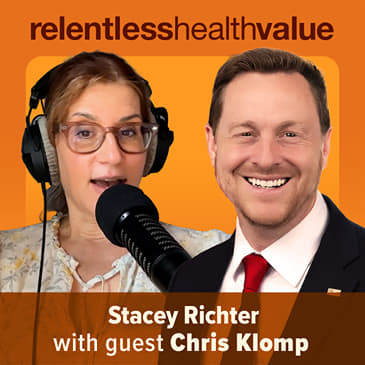
Today we are dipping into the archives for an essential replay from 2016, one decade ago, featuring Chris Klomp back when he served as CEO of a company called Collective Medical.
With the nomination of Chris Klomp to serve as deputy secretary of the Department of Health and Human Services (HHS), all eyes are kind of on how he plans to manage a nearly $2 trillion federal health apparatus.
For a full transcript of this episode, click here.
If you enjoy this podcast, be sure to subscribe to the free weekly newsletter to be a member of the Relentless Tribe.
Hey, turns out I have a semi-decent track record for finding the folks who are going to make a difference or who are making a difference and bringing them to you, Relentless Health Value tribe.
Or it could be that—what do they say?—twice a day a blind squirrel finds a nut. I could edit out that metaphorical mess I just made, but I'm not going to so you can fully appreciate the work that our editor, Tom Nash, has cut out for him.
Okay … so, a decade ago, Chris Klomp, as a CEO, was focused on one of the most stubborn bottlenecks in healthcare: frequent emergency department visits and systematic lack of care coordination therein.

In this conversation that follows, in this earlier episode, he broke down how real-time insights and aligned incentives can prevent avoidable hospital utilization. Listening back today provides a kind of rare, candid preview of the operational philosophy which may now shape Chris Klomp's view on health policy.
Now, you might consider this a very, very short introduction 'cause I'm wrapping up here. But never fear. Instead of chewing your ear off at the top of the show, like I normally do, I'm gonna spread my commentary inside the conversation with Chris Klomp that follows, just to kinda keep everything in context.
Also, speaking of changes around here, we are experimenting with a new way to start the show that kinda jumps right in instead of trying to figure out a, like, one-sentence title for the entirety of the episode.
Maybe I'm just terrible at titles (which might be fair enough), but it also seems like the main point or summary or takeaway of any given show, it only sorta starts to come out when the episode hits you lot, you Relentless Tribe, you listeners.
You go on LinkedIn and pull out and parse and respond, and then all of a sudden, I wish the episode had a different name or a different title based on the sometimes really crystal-clear reflections and insights that I read or hear about later on and after the dust settles.
So, if you have thoughts on this—seems like a big deal to us, but maybe it's not a big deal to you—if you have any thoughts, do share. This is Relentless Health Value.
Thank you so much to Aventria Health Group, which is our founding sponsor.
Thank you also so much to our series underwriter in 2026, Payerset. And I just wanna let you know that Payerset just posted about 129,000 self-funded employers' allowed amounts on their Web site for free. So, do go over to Payerset's Web site if you wanna check that out.
Also, thank you very much to Patient Rights Advocate for a really, really nice donation this year. It's so important to helping keep this show on the air.
Again, this is the show from 2016 with Chris Klomp.
Also mentioned in this episode are Tom Nash; Arielle Bose; Aventria Health Group; Payerset; Patient Rights Advocate; Collective Medical Technologies; Mick Connors, MD; Al Lewis; Peter Smulowitz, MD, MPH; Leah Honigman, MD; Bruce Landon, MD, MBA; John Lee, MD; Monica Lypson, MD, MHPE; Kenny Cole, MD; Scott Conard, MD; and Jerry DiMaso.
For a list of healthcare industry acronyms and terms that may be unfamiliar to you, click here.
Chris Klomp is the chief counselor at the U.S. Department of Health and Human Services. He has driven healthcare reform at state and federal levels, focusing on value-based care and interoperability. He built Collective Medical; has co-founded, advised, and served on the board of many innovative start-ups and on the Utah Digital Health Services Commission; and worked at Bain Capital and Bain & Company. Chris holds a bachelor of arts degree with honors in economics and English from Brigham Young University and an MBA from Stanford.
00:00 Introduction to this episode.
04:38 Reducing wasteful spend in healthcare.
05:37 The percentage of total healthcare costs that goes to emergency medical spend in the U.S.
07:09 Why ED spending is low-hanging fruit.
08:17 How EDs operate as choke points.
09:14 Impacting what happens in the emergency department.
17:34 What happens when a patient enters the ED.
20:57 Why it's important to have data available to everyone who might touch the patient.
23:44 EP495 with Mick Connors, MD.
23:58 Research from Peter Smulowitz, MD, MPH; Leah Honigman, MD; and Bruce Landon, MD, MBA.
24:45 The need-to-know when it comes to managing data.
28:01 Thinking about risk and imminent readmission.
30:01 Collaboration in a care plan to reduce wasteful spend.
30:53 The right data, risk analytics, communication, and community-wide collaboration.
31:11 How social determinants affect wasteful spend in the ED.
32:21 EP322 with Monica Lypson, MD, MHPE.
35:40 EP473 with Kenny Cole, MD.
35:54 EP391 with Scott Conard, MD.
Recent past interviews:
Click a guest's name for their latest RHV episode!
Evan Anderson, Jake Velie and Keith Hartman, Dr Eric Bricker, Yashaswini Singh, Mark Cuban and Cora Opsahl, Dr Cristin Dickerson, John Quinn
[00:00:00] [SPEAKER_03] Today, we are dipping into the archives for an essential replay from 2016, one decade ago, featuring Chris Klump, back when he served as CEO of a company called Collective Medical.
[00:00:18] [SPEAKER_03] With the nomination of Chris Klomp to serve as Deputy Secretary of the Department of Health and Human Services, HSS, all eyes are kind of on how he plans to manage a nearly $2 trillion federal health apparatus. Hey, turns out I have a semi-decent track record for finding the folks who are going to make a difference or who are making a difference and bringing them to you, Relentless Health Value Tribe.
[00:00:46] [SPEAKER_03] Or it could be that, what do they say, twice a day a blind squirrel finds a nut. I could edit out that metaphorical mess I just made, but I'm not going to. So you can fully appreciate the work that our editor Tom Nash has cut out for him.
[00:01:05] [SPEAKER_02] Hi, this is Arielle Bowes. I've reflected on this a great deal and honestly feel that listening to Relentless Health Value has given me more actionable insight than I could ever hope to receive from another graduate degree. And it cost me absolutely nothing to listen and learn. If you want career growth in healthcare or insurance, this is the pod you need to be listening to. I highly recommend signing up for the weekly newsletter.
[00:01:31] [SPEAKER_02] It's a great resource because it includes all of the links mentioned in the show, plus a full transcription of Stacey's intro.
[00:01:38] [SPEAKER_03] Okay, so a decade ago, Chris Klump, as a CEO, was focused on one of the most stubborn bottlenecks in healthcare. Frequent emergency department visits and systematic lack of care coordination therein.
[00:01:59] [SPEAKER_03] In this conversation that follows in this earlier episode, he broke down how real-time insights and aligned incentives can prevent avoidable hospital utilization. Listening back today provides a kind of rare, candid preview of the operational philosophy, which may now shape Chris Klump's view on health policy.
[00:02:25] [SPEAKER_03] Now, you might consider this a very, very short introduction because I'm wrapping up here. But never fear, instead of chewing your ear off at the top of the show like I normally do, I'm going to spread my commentary inside the conversation with Chris Klump that follows just to kind of keep everything in context.
[00:02:45] [SPEAKER_03] Also, speaking of changes around here, we are experimenting with a new way to start the show that kind of jumps right in instead of trying to figure out a like one sentence title for the entirety of the episode. Maybe I'm just terrible at titles, which might be fair enough, but it also seems like the main point or summary or takeaway of any given show.
[00:03:09] [SPEAKER_03] It only sort of starts to come out when the episode hits you lot, you relentless tribe, you listeners. You go on LinkedIn and pull out and parse and respond. And then all of a sudden, I wish the episode had a different name or a different title based on the sometimes really crystal clear reflections and insights that I read or hear about later on and after the dust settles.
[00:03:35] [SPEAKER_03] So if you have thoughts on this, seems like a big deal to us, but maybe it's not a big deal to you. If you have any thoughts, do share. My name is Stacey Richter. This is Relentless Health Value. Thank you so much to Aventria Health Group, which is our founding sponsor. Thank you also so much to our series underwriter in 2026, Payerset.
[00:03:56] [SPEAKER_03] And I just want to let you know that Payerset just posted about 129,000 self-funded employers allowed amounts on their website for free. So do go over to Payerset's website if you want to check that out. Also, thank you very much to Patient Rights Advocate for a really, really nice donation this year. It's so important to helping keep this show on the air.
[00:04:25] [SPEAKER_03] Again, my name is Stacey Richter, and this is the show from 2016 with Chris Klump. Welcome to Relentless Health Value, Chris.
[00:04:36] [SPEAKER_01] Thanks so much, Stacey. It's great to be here.
[00:04:37] [SPEAKER_03] When people talk about reducing wasteful spend in healthcare, there's a checklist, I'm going to say, of usual suspects to focus on. And curtailing unnecessary emergency department visits is, generally speaking, on that shortlist.
[00:04:55] [SPEAKER_03] So color me surprised when last time we spoke, you had mentioned that a somewhat small percentage of overall healthcare cost is actually attributed to the ED, the emergency department.
[00:05:08] [SPEAKER_01] You look at these sensationalized media headlines, and you'll read these stories like, 80% of emergency department visits are avoidable or addressable, or 90% are avoidable, and all these patients coming in for all the wrong reasons. And yet, you go talk to emergency physicians themselves, and they'll tell you a very different story. And so you sit and wonder, well, what is it? Like, what's the real answer? And there's actually been a huge volume of research on this topic, and the answers vary.
[00:05:37] [SPEAKER_01] But most accounts that seem to be best researched suggest that emergency medicine spend as a percentage of total healthcare cost in the U.S. is really only somewhere between 2% and 4%.
[00:05:49] [SPEAKER_03] Remember, Tribe, this show is from 2016. So 10 years have gone by, and we are now up to 6% on average for plan sponsors, at least. That is how much goes to the emergency room spend, 6%. Listen to episode 467, which is actually a wrap-up of multiple earlier conversations connecting the increase in emergency room ED, emergency department spend, to a bunch of things.
[00:06:26] [SPEAKER_01] Which means that mathematically, avoidable ED spend just can't be more than 0.8, 0.9% of total spend. Now, in a country where you're spending $3 trillion a year, in healthcare, 1% even of $3 trillion is still a real number, and it's worth paying attention to.
[00:06:45] [SPEAKER_01] But if you're a management consultant, and you've been engaged to advise your hospital or health system or payer customers on reducing spend, it's probably not the first place that you would go looking for pennies to save. And yet, it's politicized, and the media has grabbed onto it. I think otherwise well-intended individuals maybe don't totally understand exactly the facts and what's taking place in that channel.
[00:07:08] [SPEAKER_03] Do you feel that it's politicized and publicized and high on that shortlist because it is a low-hanging fruit?
[00:07:20] [SPEAKER_01] It's low-hanging fruit in that it's obvious. So, and I'll share some stories today that put a finer point on this, but you hear these patient stories of individuals who will hit the ED 50 times or bounce around emergency departments in pursuit of opioids. And indeed, that's happening, and we clearly are facing a public opioid epidemic in many states across the country right now. So, that's an easy place for people to grab onto. And by the way, I'm not even remotely suggesting we shouldn't focus on emergency medicine.
[00:07:48] [SPEAKER_01] I'm simply suggesting there are different reasons why we might focus on emergency medicine and emergency departments as an instantiation point at which to begin to identify complex patients in their many forms, and then pursue and mitigate the risk associated with those individuals.
[00:08:06] [SPEAKER_03] Now, this point right here aligns so precisely with all of those more recent aforementioned shows I was talking about the last time I popped in here. Emergency departments are, well, there are many things, but one is a critical choke point through which complex, often high-risk patients inevitably pass. And that choke point may be used as a funnel for profitable or otherwise inpatient admissions.
[00:08:36] [SPEAKER_03] Just to rewind for a sec so that people know who you are, my friend, I'm going to read two sentences about Collective Medical Technologies, which is your company. Collective Medical Technologies is a tech company that helps providers and payers take better care of their patients using real-time data and collaborative care planning tools. Collective Medical Technologies is a tech company that helps people in their lives and the other countries. Collective Medical Technologies is a tech company that helps people in their lives and help you to help them in their lives.
[00:09:06] [SPEAKER_01] Collective Medical Technologies: That might be a big assumption, but I'll do my best to keep pace and not let you down.
[00:09:14] [SPEAKER_03] Collective Medical Technologies, Ph.D.: How much of reducing avoidable emergency department visits happens because you're able to impact what happens in the emergency department? And how much happens because you're using real-time data in some fashion and identifying the patient in the emergency department for better care? I mean, what's the breakdown?
[00:09:37] [SPEAKER_01] If you look at the emergency department's spend, we've already established and said, all right, well, it can't be that much money. So that's probably not why we would otherwise start in the emergency department. And yet, there are good reasons to start in the emergency department. And I'm particularly emphasizing the word start. It's not that we solve all of these problems in the moment when the patient shows up in the ED. The biggest reason is that the emergency department, as you know and as most people know, is a clearinghouse for most pathologies, be them physical, mental, behavioral, or social.
[00:10:07] [SPEAKER_01] Given low barriers to entry, a complex healthcare system that's otherwise challenging for many individuals to navigate, everybody sees the big emergency department sign and they know that if they walk in, they will get the care that they need. And so all of these patients, sometimes for malintent and sometimes through misintent, present in the emergency department.
[00:10:29] [SPEAKER_01] But that creates a great opportunity because it becomes this natural choke point through which all of these pathologies and all of these patients are clearing. And if you want one opportunity to systematically identify individual patients who are at risk of otherwise avoidable future state outcomes from occurring, that's a pretty good place to pay attention.
[00:10:52] [SPEAKER_01] As an example, one of our large clinical group customers in the Pacific Northwest, which by the way, for context, already has had for some time a very high functioning, sophisticated comprehensive care management set of resources in play, has reduced its hospital readmission rates by something close to 40%. And it's done it sustainably now over the last couple of years. And when we went and said, hey, what's going on? How are you doing this?
[00:11:18] [SPEAKER_01] They said, well, now in real time, using real time data and coordinated care plans, we can not only identify our patient members who have imminent risk, but we can do it preemptively. And we can immediately engage and mitigate this risk in a way that ensures that any provider that touches one of our patients is aware of what the plan of care is, operates from that plan of care. The patient gets a consistent set of care interventions and as a result tends to have better outcomes, not only clinically, but economically.
[00:11:48] [SPEAKER_03] Let me just interject for a sec. In that particular example, and it's really putting a fine point on it, what you said about how the ED is a clearinghouse, because that's where people bubble up to the top and are able to raise their hand and have the system realize that these are the patients that are at risk and need help. But is the object of the game to keep those patients out of the emergency room for the very first time to begin with?
[00:12:15] [SPEAKER_03] Or is it they need to show up in the emergency room for that very first visit in order to get identified?
[00:12:21] [SPEAKER_01] Yeah, the object of the game is to get patients to exactly the right care setting for them in the moment to make sure they get the best possible care from the individual or individuals who are best positioned to render that care. It might be in the emergency department. If I've had an accident, I've chopped my arm off, I should definitely go to the ED and there is no better place for me. If I have some chronic or long-term complexity, or perhaps it's an addiction-related issue, then maybe the ED isn't the best place for me.
[00:12:51] [SPEAKER_01] So it's not that we want to keep people out of the emergency department. We want the right people going to the emergency department and we want other people going to primary care and staying within their health homes or getting home health or post-acute care or specialty care, whatever it is that they may need in the moment.
[00:13:08] [SPEAKER_03] So just in sum, in the emergency room through line show that I have mentioned link in the show notes, I cite research calling the emergency department the gateway to the rest of the healthcare setting. That is very concordant with Chris Klomp here calling the ER slash ED a natural clearinghouse where patients with unmanaged physical, behavioral, and or social complexities bubble up.
[00:13:37] [SPEAKER_03] If across the country, we'd have done a lot of the things that Chris is suggesting in this show 10 years ago, it makes me wonder how things would be different now. But like any good Monday morning quarterback, I can tell you that is not the case.
[00:13:53] [SPEAKER_01] So let me give you two stories to put a finer point on this. First one of malintent. So this is the classic opioid seeker example. We're all familiar with it. This comes from one of our physician users who said, you know, I started interacting with the patient. You know, the patient presented for some low acuity diagnosis. Let's call it lower back pain or abdominal pain. Maybe it was a migraine. And the physician asked the patient, well, how many times have you been to the emergency department? Patient response, oh, you're just the first time this year.
[00:14:22] [SPEAKER_01] And the provider was looking at a report that showed that the patient had had 17 other emergency departments just in the prior month, all related to migraines. And so the doctor explained that they needed to have a conversation about this. And it turns out the patient, and I appreciated this moment of honesty, hopped up, took off his gown, and said, yeah, I was actually just here looking for narcotics. And so, you know, took off. And that was the end of it.
[00:14:51] [SPEAKER_01] So what happened in that situation? The patient didn't obviously accomplish his personal objective in the emergency department. In that particular instance, we also didn't succeed, though, in giving the patient probably where he needed to go, which is to a primary care provider, perhaps somebody who could author a pain contract and place that on file for the patient, maybe over to addiction recovery services. But there are other needs in the emergency department, maybe through misintent.
[00:15:17] [SPEAKER_01] So this, I think, illustrates the value of not just real-time data flows, but the power of collaboration. This comes from the Sequoia Assertive Community Treatment Team, which is an ACT team in Oregon, particularly focused on complex mental health issues. And they had a patient under their care, a female who was homeless. And she had an appointment for a housing voucher with the housing authority so that she would no longer be living on the streets.
[00:15:46] [SPEAKER_01] And the day before her appointment, she was having really disorganized thoughts. And she didn't think she'd be able to follow the instructions or show up to her appointment. So instead, she went back to the emergency department because she knew where it was. She knew them. She knew that was a place she could get care. And immediately, Sequoia's ACT team was alerted that this patient was sitting in their emergency department. And the case manager was able to go to the emergency department, find the patient, arrange for a special appointment with the housing authority,
[00:16:15] [SPEAKER_01] personally took her to that appointment so that the patient could get a voucher and no longer be homeless. And she's not today. The point is that if everybody wasn't operating on the same page, the ED wasn't aware of this patient's particular needs. The ACT team coordinator wasn't aware that the patient was sitting in the ED. She would have missed her appointment. That cycle of recidivism would have continued. You know, so on and so forth. Fundamentally, I think so much of the value of what we do is driving specific insight to the right person best equipped
[00:16:44] [SPEAKER_01] to help a patient in real time and to empower real-time intervention so that care managers and others can do their job before a crisis. Right. Preemptively to prevent further crisis.
[00:16:55] [SPEAKER_03] Just very granularly, because this has actually come up in a couple of conversations over the past week. Say that you have the real-time data to indicate that you know for a fact that a patient is suffering from a chronic disease. They ran out of insulin, for example, or any other chronic condition, which they really shouldn't be in the emergency department for. But yet, this patient has just walked through the front doors of the emergency department.
[00:17:24] [SPEAKER_03] But at that point, they're kind of nameless. You know, unless someone recognizes them, nobody knows whether they should be there or should not be there at that exact time.
[00:17:34] [SPEAKER_01] Right.
[00:17:34] [SPEAKER_03] So they walk up to the front desk and they give their name. What's the process there? Is the object at that moment to stop the patient from entering into the emergency room system and to refer them to the clinic down the hall? Or do they sort of have to have that one emergency department visit to get processed and put into, let's just say, a more productive care pathway?
[00:18:00] [SPEAKER_01] Yeah, great question. No, so the visit will absolutely occur in that moment. The goal is not to stop that visit in the least. Not only because that patient clearly has some need for why they've presented in the emergency department in the moment. And providers, I think, are morally and ethically obligated to assess that need for themselves and to make sure that that patient has rendered the care that he or she needs. But it's required under Emitala and otherwise. The goal then, though, is to make sure that that patient doesn't become a subsequent high utilizer
[00:18:29] [SPEAKER_01] or the existing or pre-existing pattern of high utilization doesn't persist. But you brought up an interesting question in the way that you phrased or the statement that you made when you phrased that question. What information do the providers even have in that moment when the patient first shows up in the waiting room and is registering? So in that moment, we then immediately set about to identify that patient, to aggregate their prior encounter history, to composite a longitudinal patient history,
[00:18:56] [SPEAKER_01] and then to begin looking for patterns of risk that suggest that this patient has some specific need or set of needs about which the provider with whom presently the patient is about to interact may not be aware. And then to make sure that the provider is aware, not only of that prior history, but particularly if there's a plan of care or the patient requires a plan of care, that that information is surfaced. You might have a patient who's hopped around to five different emergency departments,
[00:19:23] [SPEAKER_01] each of which assigned a case manager to work with that patient, unbeknownst to any other case manager or any other facility. And even when you can bring in health information exchange and aggregate all these plans of care, that's timely and requires some sort of a manual reconciliation process. And yet, you still have this same patient sitting in your emergency department right now. Here's an example. This comes from our chief medical officer. In particular, he indicates that they had a large population of sickle cell anemia patients whom they would treat.
[00:19:53] [SPEAKER_01] And in many instances, these patients would present in severe pain. But not always would you know if this was an authentic need or what the plan was. He said, you know, this is, you know, a decade ago, they would place these patients in soundless rooms, far from the nursing stations that no one would hear them scream. And then everyone available, it would be all hands on deck, nurses, medical students, social workers, would be calling every number that they had from the pharmacy to primary care to other hospitals, trying to validate who this patient was, what their needs were,
[00:20:22] [SPEAKER_01] and validate the enormous amount of opiates that the patient actually needed. Gosh, talk about this arcane process that's really not meeting the patient's needs. And yet, when we operate, all of a sudden now, a primary care provider that's working with the patient can put a note in and make sure that any other provider that touches that patient knows, okay, here's the plan of care. This is a sickle cell anemia patient. He or she has legitimate needs for pain management. This is the plan. And if you interact with this patient, you need to follow the plan.
[00:20:52] [SPEAKER_01] You need to make sure that they're getting the care that they needed.
[00:20:53] [SPEAKER_03] I'm just getting the framework for the overall construct. What is really necessary is to make sure that there is data available to everyone who might have the potential to touch the patient so that ideally, if they show up in the emergency room because they fell off the care plan or the care plan was insufficient in some fashion, that at least those in the emergency room understand what else is going on in order to help the patient
[00:21:22] [SPEAKER_03] get back into the care plan or to adjust the care plan accordingly. Or if this is the first time that anyone is really seeing the patient or no one quite realized that a care plan was necessary, that the patient can be referred elsewhere in the system in order to get the care that they need. Would that be kind of a summary of the overall idea?
[00:21:41] [SPEAKER_01] Yeah, that's a fantastic summary. So it's how do you equip the providers in the moment with the information they need to level set a baseline to engage with the patient right now? And then how do you automatically engage other providers downstream, primary care and others, who can have longer term responsibility for this patient in a more appropriate non-emergent and arguably therefore more cost-effective care channel? You phrased the question and said, it's about the information that you don't know. I had this, it reminded me, I had this Israeli mathematician for a professor in graduate school.
[00:22:10] [SPEAKER_01] Crux of his work is that it's not the information that we know or the information that we don't know that most directly and significantly impacts the outcome of a situation, but it's the information we don't know we don't know. So the unknown unknowns. If you think about the role of an emergency physician or nurse, we have a team member who said he used to work in rural emergency departments. He said the loneliest place to be is an emergency department at two in the morning
[00:22:37] [SPEAKER_01] when a patient shows up about whom you know absolutely nothing.
[00:22:42] [SPEAKER_03] That's also probably where that 4% or the 2 to 4% number that you cited at the very beginning, that if you look at simply what percentage of the overall healthcare spend is due to emergency rooms, this is also probably how that number might be considerably larger. If you look at emergency department as the tip of the iceberg.
[00:23:03] [SPEAKER_01] Right. No, I totally agree with that. Again, it's the clearinghouse. It's the entryway into the rest of the healthcare system, which obviously leads to far greater spend for many of these complex situations. And by complex patients, I mean high cost, high needs patients. It could be high utilizers who are generating five or more ED visits in a 12-month period. It could be emerging utilizers. Maybe it's the pediatric asthmatic patient who's just hit the ED for the second time in 72 hours.
[00:23:29] [SPEAKER_01] By no definition is that patient, I quote, high utilizer. And yet, statistically, that utilization pattern is far beyond the median utilization pattern and is likely to lead to more complexities down the road.
[00:23:44] [SPEAKER_03] Listen to the episode with Dr. Mick Connors on kids in the emergency room, especially when they cannot access primary care. And also the one with Al Lewis. This is episode 464.
[00:23:57] [SPEAKER_01] Yeah, there's really good research on this topic. I think it's some research out of Harvard and Boston. Peter Smolowitz, the Hahnemann, Bruce Landon called the ED the gateway to the rest of the healthcare setting. So yes, the ED counts for 2% to 4% tops, but lots of other spend, lots of other complexity that ensues.
[00:24:14] [SPEAKER_03] The one thing that obviously is pretty evident that underpins much of what we're talking about is making sure that you have the right data in the moment and that that data is fairly real time, especially if you're talking about a pediatric patient who just showed up a couple of days ago. I mean, if you're trying to rely on claims data or something like that, you figure out that that pediatric asthma patient had three visits in rapid fire three months ago. It doesn't help you much.
[00:24:39] [SPEAKER_01] Not that helpful.
[00:24:40] [SPEAKER_03] I know that collective medical technology is like, this is your gig. But if you're giving advice to health systems or payers who are trying to manage this, what are the main things that someone would need to know about managing data such that you can identify these patterns of risk that you're talking about?
[00:25:00] [SPEAKER_01] Love that question. This is our bread and butter. And it doesn't matter if you're using our system or any other. I love the concept of population health. What I don't love is exactly what you just articulated, which is for the most part, at least the first whole generation or two of pop health software is centered around claims data based inputs. And that's all well and good. And it allows you to assess the overall health of a community. But if you want to drive that down to point of care, patient specific instructions,
[00:25:27] [SPEAKER_01] intervention opportunities, by the time you've got your claims data, and then you've processed it, you're 90 to 120 or 180 days late. And most risk is probably already manifest. You're like way too late. In fact, we have this managed care organization customer. They're really forward thinking. They do this amazing case management work. And they started this pediatric education campaign for their members. And they would call the parents of these patients once they found out that they were in and they were using their claims data to do this.
[00:25:56] [SPEAKER_01] But that's kind of an awkward and not that helpful conversation. If you say, hey, Mr. and Mrs. So-and-so, I saw that your daughter was in the emergency department four times like three months ago. And did you know that you could have gone to your primary care provider pediatrician? It's like, yeah, okay, great. Why didn't you help me then? Not that helpful. But if at nine in the morning, that same case manager is aware that the patient was just in the emergency department that night, much more timely call to say, hey, I saw that you were in the ED at three this morning.
[00:26:25] [SPEAKER_01] That must have been lousy. Did you know that you have access to a free 24-7 nurse hotline? Or there's an urgent care center that's more cost-effective for you. That is a meaningful conversation. And by the way, that managed care organization has had huge impact and very meaningful results in curbing unnecessary through misintent pediatric utilization in the emergency department and beyond. But that's not totally your question. So you're wondering, so what are the big building blocks of what's necessary? I think there are probably four.
[00:26:55] [SPEAKER_01] The first is data. And for us, this is real-time data. And I mean truly real-time within seconds data. So you need it for two purposes, really. One, to identify the patient. And two, to composite some sort of longitudinal history of where that patient's going, why with whom they're interacting, so on and so forth. We take a very different approach than most on this, which is we aren't trying to aggregate all the data under the sun. There are lots of problems, both politically and technically, with doing that. It's challenging.
[00:27:24] [SPEAKER_01] We're big believers that most healthcare data should live within the EHR, within the corresponding healthcare providers domain. You actually only need a small slice of data, and you need to use it appropriately, and you can drive tremendous amount of value. So for us, this is starting with an ADT feed, an admin transfer discharge feed.
[00:27:42] [SPEAKER_03] With all the interoperability and data portability advances in the past 10 years, you would think this near real-time data feed would be a lot easier now than earlier. But someone closer to this than me should weigh in here. Dr. John Lee, I might be looking at you.
[00:28:01] [SPEAKER_01] The second component, I think, is you need some really intelligent or thoughtful ways of thinking about risk. So for us, these are real-time risk analytics against that encounter data. Looking for patterns of risk. Is this patient at risk of imminent readmission based on their sociodemographic profile cross-tabbed by prior encounter history? Is this patient readmit within the last 15 or 30 days from some other channel? If so, where were they? Why did they have CHF or COPD or some other complexity that should inform meaningfully the
[00:28:29] [SPEAKER_01] current providers for several minutes of engagement with the patient? Does this patient have a care plan on file? If so, what is it? And gosh, wouldn't every provider want to be aware of what the plan of care is, even if they're going to ignore it or do something else because the patient's presenting for some other reason. But you need risk analytics, not compositing just these huge scores in the cloud, but in the moment for the provider to know when they should engage. I think the third thing then is communication. So it's great if you have a web portal.
[00:28:56] [SPEAKER_01] It's great if you allow providers to access this information. But unless you deliver timely, real-time insight in a highly synthesized way that meets the provider's workflows and you do that intimately integrated within their workflow, and by this I generally mean it and you need to live in the EHR because that's where providers live and that's where they go, then that's what you do. So for example, if you just go shadow an emergency department provider or physician or nurse, they will go to their ED bed board.
[00:29:25] [SPEAKER_01] They'll figure out which patient they're supposed to go see next. They'll go pull back the curtain. They'll start asking questions, ordering tests, and treating the patient. And they do that really well. But that means if you want to influence their decision making, you need to live on that bed board. And if you have something relevant to share with that provider, you need to share it on the bed board and grab their attention. And they need to trust you that if you speak up, if you throw a flag or an icon on the bed board and they click it, that you're not going to waste their time.
[00:29:53] [SPEAKER_01] You're going to deliver your message succinctly and in a timely fashion. And it's going to be on point and cause them to do something differently. And the fourth component is collaboration, like we've been talking about. So we're trying to destroy this construct of who owns the care plan. Well, nobody owns the care plan because nobody owns the patient. This patient is hopping around from facility to facility and no one facility is able to meet that patient's needs, which means we have to introduce a new construct, which is true community-wide collaboration.
[00:30:23] [SPEAKER_01] Meaning anybody who touches this patient is on the patient's provider care team and they all need to be contributing against one common plan of care that's specific to that patient's whole person care needs. And we think when you put those four elements together, each of which different providers have access to, it's the kind of intimate marriage of all four components, you can drive meaningful differential clinical outcomes that can be measured and iterated against. And that's what we care about.
[00:30:52] [SPEAKER_03] Wow, I love it. Okay, so we've got the right data. We've got risk analytics. We have communication and we have community-wide collaboration.
[00:31:00] [SPEAKER_01] Nailed it.
[00:31:00] [SPEAKER_03] One of the things that you had said earlier struck me. You had given an example about a homeless woman who came in and was identified as having needed additional care. And obviously, emergency rooms, one of the biggest factors that often is discussed is social determinants, which gives certain patients a higher proclivity to show up in the ED.
[00:31:20] [SPEAKER_01] For so long in healthcare, we've thought about physical health as one thing, so much so that we actually just called it medical health, as though mental and behavioral complexities weren't medical in nature. So we're pretty focused on this idea of social determinants and their ability to help not healthcare providers, but others more generally preempt avoidable risk, which is our mission as a company.
[00:31:43] [SPEAKER_03] Huh. This is interesting. The gravitas afforded to social determinants here. The situation a patient finds themselves in, which is treated as a scenario to deal with and deal with effectively. And maybe it boils down to incentives. I could go on a tangent. I will not. The point becomes pretty clear, though, that not dealing effectively with these larger scenarios,
[00:32:13] [SPEAKER_03] ecosystems, community issues costs everyone more than dealing with them effectively would cost. Listen to the episode about social determinants and the VA, the Veterans Administration, with Dr. Monica Lipson. Link in the show notes.
[00:32:29] [SPEAKER_01] So let me illustrate it with a story. This comes from Northwest again. We'll talk about a man. Let's call him Ron. That's not his real name. But Ron was an aggressive ED high utilizer. And at his peak, he hit the emergency department 23 times in a month. It was spread across seven different hospitals. No one hospital really saw him as a critical high utilizer. But in the aggregate, he was incredibly material. Ron is always presenting with a new injury or symptom and is nearly always in pursuit of narcotics.
[00:32:58] [SPEAKER_01] Now, it turns out that Ron was managed or under the purview of a primary care provider called Family Care Health. This is in Oregon. And once we launched our services in Oregon, all of a sudden, Family Care gained awareness of what was happening with Ron. And so on his next subsequent emergency department visit, our analytics determined this was a high risk scenario, obviously, and flagged this for this Family Care Health Care coordinator. And each time Ron would hit the ED, the coordinator would be notified.
[00:33:26] [SPEAKER_01] And in a true testament to, I think, the virtue and best intentions of healthcare providers, this gentleman, this care coordinator would immediately get in his car, drive to the emergency department, call the ED on his way to let them know he was coming, and then go meet with Ron. What he figured out is that Ron had a number of developmental disabilities. And he actually quoted and said, Numerous social determinants that were affecting Ron's health. Ron was homeless. He was living in his truck.
[00:33:53] [SPEAKER_01] He had a cell phone, but he couldn't keep it charged because he was homeless and living in his truck. He had a female travel companion who would come with him to the ED. And once this care coordinator separated Ron from this travel companion, it turns out that the female travel companion was actually coaching Ron on certain injuries and even on occasion would inflict injuries on Ron so that he would appear more legitimate in the ED. Now, all of a sudden, this whole hornet's nest of complexity, spanning physical, mental, behavioral, and social pathologies,
[00:34:22] [SPEAKER_01] all related to one patient, started to become evident. And so within our system and beyond, this family care care coordinator first called Adult Protective Services, then began to build a relationship with Ron. And over time, documented this very comprehensive community-wide plan of care, which spanned Ron's physical health needs, his mental behavioral health needs, and his social needs. And each time Ron would present somewhere across the community,
[00:34:49] [SPEAKER_01] each provider, each stakeholder would be notified of Ron's specific needs. As a result, Ron's story is a positive one. He's now getting his medications, his diabetes and blood pressure under control and being managed. He still goes to the ED from time to time, but his peak visit count or utilization is down from 23 visits a month to three at peak. We realize in our own data that of ED high utilizers, 78% of those individuals are presenting with physical, mental, behavioral health comorbidities,
[00:35:17] [SPEAKER_01] which means if you want to meet the needs of that patient over the long term, you cannot simply focus on physical health. You have to think about the whole person care. You have to think about social determinants. So for us, this means bringing in data to inform our risk models, but also bringing in collaborators outside of healthcare further upstream in the social determinants space with community-based organizations and beyond.
[00:35:40] [SPEAKER_03] The show with Dr. Kenny Cole on how important whole person health is and trust is would be a great follow-on right here for those looking for more insight. And after you get inspired by Dr. Cole, listen to the first show with Dr. Scott Conard for the, as he called it, pelican brief moment when his whole person health practice
[00:36:04] [SPEAKER_03] that was meaningfully reducing the need for, turns out, unnecessary hospitalizations was actually dismantled by the local hospital chain who called it their fiduciary responsibility to keep hospital beds full. Or maybe switch around the order of those two listens and listen to Dr. Dr. Conard first and then Dr. Kenny Cole, if you want the bad news about perverse incentives and then end on a high note. I thank you so much for being on the podcast today, Chris.
[00:36:35] [SPEAKER_01] Thank you. I appreciate it, Stacey.
[00:36:37] [SPEAKER_00] Hi, I'm Jerry DeMasso, CEO and co-founder of Payerset. Relentless Health Value is one of the best resources out there for understanding how healthcare really works. And it's actually required listening for anybody that comes on board at Payerset. Stacey gets into the real mechanics of healthcare pricing and what it takes to fix this system. If you care about making healthcare more affordable and transparent, this is the show to tune into. I highly recommend signing up for the weekly newsletter. It's a great resource because it includes all the links mentioned in the show, plus a full transcription of Stacey's intro.
[00:37:06] [SPEAKER_00] The conversation continues online. Follow Relentless Health Value on LinkedIn to join the community and share your own perspective. Please be sure to follow the podcast on Apple Podcasts or Spotify and forward this episode to someone who should be listening.