
You know, I always kind of wondered what the hackers were doing with all of the medical data that they've managed to get their mitts on over the past, I don't know, however many years. Now, I know at least one thing. If you're a hacker, you can use your stolen medical data to not actually send wildly overpriced catheters to seniors across the country but then you bill CMS (Centers for Medicare & Medicaid Services) anyway.
Fast-forward, CMS pays $3.5 billion in one year for all of this DME (durable medical equipment) that didn't actually get sent. If you add wound care stuff like skin substitutes into this fraudulent mix, the cost of all of this very suspicious activity adds up to 4% of the CMS budget … 4% of the budget!
For a full transcript of this episode, click here.
If you enjoy this podcast, be sure to subscribe to the free weekly newsletter to be a member of the Relentless Tribe.
I was gonna say something about the inches are all around us, but in these past few shows, we've got inches that have so many zeros. Four percent of the CMS budget, by the way, is more than all of home care or something like this.
So, as just one consequence for all of us, enjoy your personal and/or corporate tax dollars going to buy some Eastern European hacker a yacht or something like that.
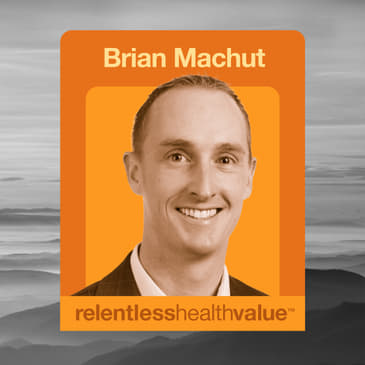
But that's not really what I wanted to talk about today in my conversation with Brian Machut. What I wanted to talk about today with Brian—who is an actuary from Alliant Health, by the way—what I wanted to do first of all is just a little level setting where mostly Brian blows my mind with just the wildly adventurous level of grift that seems fairly glaring here. But what do I know?

What I wanted to mostly talk about after that, though, is how all of this impacts shared savings, potentially, if you're an ACO (accountable care organization). And then from there, why that actually has downstream impact for plan sponsors such as self-insured employers—and it does actually have a downstream impact in multiple ways.
Here's a big honkin' spoiler alert: This fraud, the 4% of the budget, it can and some of it is getting passed on in the form of higher expenses for attributed patients in ACOs with shared savings—MSSP (Medicare Shared Savings Program) and REACH (Realizing Equity, Access, and Community Health)—programs.
Because these ACOs who might do the most amazing job helping Medicare help patients not cost as much. And then they get walloped in the back of the head if one of these skin substitute companies gets ahold of one of their attributed patients, covers their entire body or whatever in skin substitutes that they're charging for by the centimeter, and then the cost of that attributed patient gets high, and then the ACO misses their shared savings mark.
There's another implication for ACOs that has to do with trend. Bottom line, there are several different ways that the fraud can be a detriment to providers, including independent providers who are in these ACO programs, meaning they make less money than they thought they were gonna make. And look, if you're a provider on the clinical side of the house, this obviously is a problem.
But it also, for sure, impacts plan sponsors in several different ways. Let me briefly outline a few, but definitely listen to the conversation for the deep dive here. First, you want PCPs (primary care providers), especially independent PCPs, and other practices to stay in business, right? Especially as a self-insured employer. We have talked about this in multiple shows (see below).
Well, to do that, you gotta have some value-based care going on. It is super hard these days for a PCP, especially an independent practice, to survive on fee for service alone, let alone rejigger their practice patterns to incorporate the data and the processes to level up outcomes and the value of care delivered.
Most PCPs need a variety of value-based contracts that kind of all add up to a critical mass of dollars, a critical mass of their patients having some sort of value-based coverage so that they can transform their practice in necessary ways to manage to stay afloat.
MSSP, REACH programs is a big one of these ways to get a critical mass of additional dollars to supplement fee for service.
You take away shared savings that was expected, and it's harder. It's harder for these independent practices to stay in business, then they go over or get bought by the local health system, and then rates go up and referrals go up. You get my drift. This is not good if you're a self-insured employer or a plan sponsor.
But also, and Brian says this very eloquently in the conversation that follows, so stay tuned for the better way to put this. But let's say that we're talking about a health system ACO now who has leverage with payers. They now have a budget shortfall because dollars they were expecting to come in from their ACO did not materialize.
Oh, right. Guess who gets to enjoy cost-shifted expenses in the form of higher commercial rates. Yes, my plan sponsor friends, step up to the plate.
My guest today, as I mentioned, is Brian Machut from Alliant Health. He is a value-based actuary. And if you're wondering what a value-based actuary does all day, what he does is help providers, physicians, health systems succeed in value-based care. This means performing projections about how well they will perform, why they may be performing the way that they are, what types of risks are being taken, what are good decisions, what are the types of contracts, value-based contracts, and other types of downside risk that they might wanna be getting themselves into, contract negotiations … stuff like that.
So, basically helping providers ensure they are getting a fair and equitable approach to their value-based contracts. I asked Brian about this, in case you're wondering. I was very curious what a value-based actuary does all day.
I also wanna thank Tara Lagu, MD, also from Alliant Health, who added some color and context because her mother, who has no need for a catheter but had not one but two catheters ordered for her by a company she'd never heard of and CMS paid $18,000 for these two catheters, which, by the way, Dr. Lagu's mother never received. We talk about this as well. Thank you very much, too, Dr. Lagu, for sharing that story with me.
This episode is sponsored by Aventria Health Group as usual, but I did wanna thank Alliant Health, who really kindly offered up some financial support today to help out around here with our expenses. Thank you so much to Alliant Health.
Also mentioned in this episode are Alliant Health; Tom Nash; Tara Lagu, MD; and Cora Opsahl.
Also listen to these highly relevant episodes: EP391 (Scott Conard, MD); EP413 (Will Shrank, MD); EP437 (Brian Klepper, PhD); EP445 (Tom X. Lee, MD); EP467 (Stacey); EP483 (Jonathan Baran).
For a list of healthcare industry acronyms and terms that may be unfamiliar to you, click here.
You can learn more at alliant.com and by connecting with Alliant or Brian on LinkedIn.
Brian Machut, FSA, MAAA, is an experienced health actuary with expertise in value-based payment models, healthcare care analytics, and actuarial consulting. Brian has a passion for supporting healthcare organizations in their adoption of value-based payment models, applying data to better understand health utilization and costs, developing solutions to reduce inefficiencies in the healthcare system, and helping others adopt and maintain healthier lives.
Based out of Minneapolis, Brian has been involved in a wide variety of areas within healthcare actuarial consulting. He is a leader within Alliant's Value-Based Healthcare Services practice, providing actuarial and strategic support services for dozens of provider organizations and ACOs participating in value-based contracts, with a concentration on organizations participating in MSSP, ACO REACH, and risk contracts with Medicare Advantage plans. Brian also supports organizations with actuarial evaluations and strategic recommendations for commercial and Medicaid-based risk contracts. Brian is a frequent author of Alliant white papers and briefs discussing recent developments within MSSP, ACO REACH, and Medicare Advantage.
Brian earned bachelor's degrees in actuarial science, finance, and risk management from the University of Wisconsin-Madison and is a Fellow of the Society of Actuaries.
00:00 One way hackers are using medical data to commit Medicare fraud.
01:49 What today's conversation with Brian Machut entails.
02:16 The downstream impact that this Medicare fraud can have.
03:30 A brief outline of how plan sponsors can be affected by this Medicare fraud.
06:38 What does a value-based actuary do?
08:04 The conversation with Brian Machut: What caused his team to look into DME costs and uncover Medicare fraud?
08:46 How much did this fraud scheme cost organizations in 2023?
09:57 How this data was tracked down and uncovered.
11:13 How fee-for-service ACOs work, and why this Medicare fraud affected the ACOs' shared savings.
12:46 The two codes that were the target of this fraud.
15:13 Across the U.S., how much money in 2023 did this fraud, waste, and abuse cost, and what was done about it?
16:14 The framework that was created to combat this fraud spend.
17:49 Why the CMS decision to pull those expenditures negatively affected some ACOs.
20:17 Where things stand now with this catheter fraud.
21:33 Why this fraud is still able to happen.
22:19 Is this a use case for prior authorizations?
23:49 How this Medicare fraud affects self-insured employers and what they should keep in mind.
25:12 What is the correlation to employee affordability?
27:08 A cost that dwarfs the catheter Medicare fraud.
28:21 A brief summary of skin substitutes.
29:32 What SAHS means, and how CMS uses it to calculate an ACO's shared savings.
31:21 Why CMS chose not to classify skin substitutes as SAHS.
33:26 Why this fraud affects ACOs' prospective trend pricing risk.
36:40 Why these fraud cases make participating in ACO programs less appealing to provider organizations.
38:28 Medicare Advantage Advance Notice for 2027.
Recent past interviews:
Click a guest's name for their latest RHV episode!
Ivana Krajcinovic, Dr Jacob Asher (Take Two: EP398), Stacey Richter (EP500), Dr Jay Kimmel, Mark Noel, Gary Campbell (Take Two: EP341), Zack Kanter, Mark Newman