
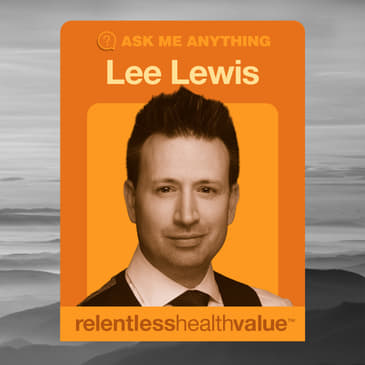
This episode is the very first episode that we have done that is an AMA—an Ask Me Anything—and here is our very first question.
Sarah Monroe: Hi. This is Sarah Monroe in Chicago, and I'm a benefits procurement leader. And I'm curious why you think so few executives take proactive bold action in health benefits strategy given the magnitude of opportunity.
For a full transcript of this episode, click here.
If you enjoy this podcast, be sure to subscribe to the free weekly newsletter to be a member of the Relentless Tribe.
Stacey: Thank you, Sarah Monroe, for that question that so many probably wonder about. To help answer said question, I shanghaied the one and only Lee Lewis. And wow, is that a good choice, if I do say so myself.
As just one place that Lee takes this conversation—which is also a wild spoiler alert, so earmuffs if you're opposed to such things—but coming up here, Lee tells the following gem of a C-suite anecdote, just so you know where this conversation is headed. Lee says, after an M&A (merger and acquisition), after an acquisition, they looked at the health plans; and the one employer had a $2,300 per year of less expense per employee, and the benefits were actually better.
So, when they moved over the employees, they made over a quarter billion dollars of instant equity value for the acquired company that nobody had priced into the calculation. Right? Nobody had thought about this or looked into it or anything, but it was a quarter billion dollars of additional value because this one company just had managed their health benefits so much better.
I don't know. That feels like the first verse of some CEO love song, right, if you ask me. But let me get organized.
This conversation has three parts. The first part is what Lee calls dogmas. By the way, they are all false. You're gonna know if you're a longtime listener of the show or even a short-time listener. You're gonna know immediately that each one of these dogmas is false.
But many CEOs may believe these three dogmas. And if they do, they're not gonna do anything with their health plan besides, as Lee says, stay in the herd. Right? Just like not be an outlier amongst comparable companies.

In brief, those three dogmas that are all false that we talk about in the conversation that follows are:
Dogma 1: Health benefits are a fixed expense.
Dogma 2: Saving money hurts people.
Dogma 3: Fixing healthcare is never worth the effort. It's high risk. It's high disruption. We've tried things before. They've never worked.
You can definitely see how if there is a C-suite that believes any one of those three dogmas, they're not gonna do anything with their health plan anytime soon.
All right … so, after we talk about the internal dogmas, Lee and I, then we talk about the potential external reasons for a lack of action by C-suites. And in brief, there are four of them. They are:
1. Circles a CEO travels in may include hanging out with health system leaders, and as I say in the show that follows, they may be drinking Kool-Aid they never realized got put in their beverage.
So many shows on what C-suites at Consolidated health systems are into. Go back and listen to some of them.
2. Balance of trade: threats and promises. Balance of trade, we talk about at some length later on. So, if you don't know what that means, you're in luck. Stay tuned.
3. Personal incentives for a CEO or others offered by some of the big status quo vendors, you know, go on trips, fancy tickets, weekends at a ranch, that kind of thing.
4. CEOs may not be all that concerned about a $5,000 deductible or a higher co-pay. But a $25-an-hour employee? Yeah … a very, very different perspective.
So, we go through each one of those four.
And then we close out this show with Lee giving one good idea after another. Let me say he is on a roll giving advice for how, even if the CEO C-suite is extremely risk averse for a benefits team to get the show on the road, to get moving, to try new things, to try to (despite or in spite of what the C-suite may want or think) move the health plan forward.
And then he gives some advice directly to any CEOs who may be in the building here. The list that Lee riffs out, again, toward the end of the show is pure, hard-fought and -won wisdom. So, if your time is limited, do skip ahead, my friend, would be my advice. You don't wanna miss the end of this episode where the plan comes together.
And speaking of the plan coming together, may I also inform you that next week we have a companion show here. We have Patrick Nelli on the podcast with a second view maybe into Sarah Monroe's original question, but we take it a little bit more specifically from the standpoint of a CFO and how to understand and speak the language of a CFO. So, do come back for that. It is a great conversation.
This podcast is sponsored by Aventria Health Group with an assist from Payerset. So, thank you very much to both Aventria Health Group and Payerset for offering the financial support to keep the show on the air.
Lee Lewis is chief strategy officer and GM medical solutions at the HTA, the Health Transformation Alliance. He is also the host of Broken Benefits.
And with that, here's our first AMA, Ask Me Anything, with Lee Lewis.
Also mentioned in this episode are Health Transformation Alliance; Sarah Monroe; Vivian Ho, PhD; Patrick Nelli; Aventria Health Group; Payerset; Eric Bricker, MD; Suhas Gondi, MD, MBA; Jerry DiMaso; Ivana Krajcinovic, PhD; Patrick Moore; Mark Cuban; Cora Opsahl; and Rob Marty.
Additional episodes discussing perverse incentives in the marketplace include EP379 (AJ Loiacono), EP406 (Lauren Vela), EP481 (Benjamin Schwartz, MD, MBA), and EP483 (Jonathan Baran).
For a list of healthcare industry acronyms and terms that may be unfamiliar to you, click here.
You can learn more by visiting htahealth.com and by connecting with Lee on LinkedIn.
You can also email Lee at llewis@htahealth.com.
Lee Lewis serves as chief strategy officer and GM medical solutions for the Health Transformation Alliance (HTA). He leads efforts across over 60 large and jumbo employers and six million employees to save lives and save millions of dollars through improved health delivery, outcomes, and experience. Key initiatives in this role include new models of health benefits administration, curated provider steerage, and improved clinical delivery and outcomes.
He has advised healthcare strategy at Fortune 10 employers, insurance companies and administrators, medical associations, and the Departments of Justice and Labor. He incubated and helped form two dozen health benefit start-up companies and has been quoted and featured in Bloomberg and the Wall Street Journal.
Lee is a founding charter member of the Health Rosetta organization and is credited as a co-founder of the Health Value Exchange.
Before joining the HTA, Lee was a consultant at Gallagher, where he founded Gallagher's innovation lab and national jumbo employer practice. In 2019, he was recognized with the industry's top honor as the Outstanding National Consultant for Large & Jumbo Employers Award by the independent Validation Institute.
Lee is a Rhodes Scholar nominee and graduated second in his class, magna cum laude with university honors, from Brigham Young University.
00:00 Introduction to this episode.
00:43 Ask Me Anything Question 1: Why don't more self-insured executives take bold action toward their benefits strategy?
03:09 A summary of the three dogmas covered in the following conversation.
05:53 A look ahead at next week's episode.
06:36 An introduction to today's guest, Lee Lewis.
08:23 Why there is an aversion to digging into health benefits for some executives.
09:43 The first dogma: Healthcare costs are fixed expenses.
09:56 The second dogma: Saving money in healthcare hurts people.
12:01 The third dogma: Fixing healthcare is never worth the effort.
12:26 How these dogmas trickle down to HR teams.
13:47 Anecdote: One company that turned down saving $50 million and why.
16:28 A quick reminder about the context behind where CEOs' mindsets are.
17:10 The kinds of employers HTA seeks out.
20:03 The power of C-suites in health systems.
21:33 EP466 with Vivian Ho, PhD.
21:36 EP404 with Suhas Gondi, MD, MBA.
21:42 Why a CEO may pull the plug on health plan/health benefit improvements.
22:37 An anecdote about Lilly cancelling their health plan.
23:21 Items that CEOs need to be thinking about.
24:33 EP506 with Jerry DiMaso.
26:07 EP501 with Ivana Krajcinovic, PhD.
26:32 A summary of why CEOs should care about their health benefits costs now.
29:02 How do personal incentives play into CEOs' decisions about health benefits?
30:44 Another quick reminder about C-suites.
31:53 Why perverse incentives make it difficult for C-suites to accept change.
33:11 LinkedIn post by Patrick Moore.
33:28 Why the salary gap plays into health benefit decisions in a perverse way.
34:58 EP488 with Mark Cuban and Cora Opsahl.
36:13 Lee Lewis's advice to people in benefits who are aligned to the mission.
40:06 Lee Lewis's advice for CEOs.
Recent past interviews:
Click a guest's name for their latest RHV episode!
Stacey Richter with 15 experts (EP507); Jerry DiMaso; Dr Ahilan Sivaganesan; Ryan Jacobs; Stacey Richter (INBW46); Ryan Wells, Dr Leo Spector, and Adam Stavisky; Brian Machut; Ivana Krajcinovic