
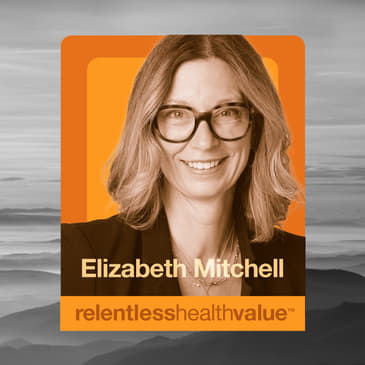
Today, back on the pod, we have Elizabeth Mitchell, CEO of PBGH, the Purchaser Business Group on Health. Elizabeth Mitchell is talking about the why, as in why did PBGH embark on a big cost and quality safety transparency data demonstration project that they just finished up? They did said project, by the way, with Milliman, Embold, and it was funded by Peterson.
This episode is a little longer than usual, and I did consider breaking it into two. But the thoughts that Elizabeth Mitchell shares are so vitally intertwined and the impact of all of this is big enough that, yeah, if you don't get through this whole show in one sitting, do come back and listen to the rest of it later on. Make your own part 2.
For a full transcript of this episode, click here.
If you enjoy this podcast, be sure to subscribe to the free weekly newsletter to be a member of the Relentless Tribe.
Okay, so on the show today, first of all, we start out by diving right into the why. Why do this demonstration project, and why do I call it a game changer? Well, simple, really. The second I saw the data showing the real price of any given healthcare service, along with its quality and safety scores for clinical organizations, and down to the individual NPIs (National Provider Identifiers) actually, I had eyebrows glued to my hairline.
Turns out (ruining the suspense, I guess), those big-brand health systems with the flashiest billboards and sports sponsorships, not always the highest quality. This isn't speculation. It's right in the scores. There is zero correlation between price and quality. Zero.
So look, this insight and ability to see prices, quality, and safety all together now done by PBGH for its large employer members—who spend, by the way, over $350 billion (that's with a "b") a year on healthcare, thus representing a very, very profitable gang of customers for many in the healthcare industry—this whole thing has big game-changing energy for these employers themselves but also game-changing ripples that extend into the businesses of other stakeholders as well. Again, let's consider a few of these.
What's the game-changing impact on consultants and TPAs (third-party administrators)? I'd say this project opens up opportunities for good unconflicted consultants and indie TPAs who know their stuff inside and out.
Because now employers have the wherewithal to deduce who the good consultants and TPAs are, which has been hard heretofore (check this post by Bryce Platt, PharmD). That's great news.
Still speaking of the impact on TPAs and consultants—but this time ones probably not listening right now—in the middle of the episode, Elizabeth Mitchell talks about TPAs and consultants getting called into their client's corporate boardroom to explain themselves after some of the results from this demo project were released to PBGH members. Awkward.
When the client knows more about the prices they're paying and the quality and safety they're getting, then they're a longtime consultant or TPA or ASO (which means administrative services only) vendor, all of whom are supposed to be the experts.
It becomes real clear, real fast that discounts are irrelevant and anybody selling discounts is gonna not look so good, even if they buy everyone in the HR department box seats to see Disney on Ice, which is just another point to ponder.
Speaking of getting called onto the carpet, Elizabeth Mitchell, again, my guest today, says during the early part of the conversation that follows, she says, "One of the other things that [our PBGH transparency] project demonstrated was that [for these jumbo employers] the directly contracted arrangements [the direct contracts] were higher value than anything negotiated by the TPAs." Oh, snap!
Elizabeth said that right after I said that I've been hearing more and more that TPAs (ie, third-party administrators) hired by self-insured employers to administer their health plan benefits, I've heard multiple times in the past several weeks that maybe TPAs should maybe just stick to administrating—administrative services only, as they say. Let someone else do the negotiating.
For example, let employers just direct contract themselves. There's only so many times you can hear that the cash price is cheaper than the TPA- or carrier-negotiated rate before this occurs to someone.
Check this link to a crazy Instagram that Kurt Christie sent me on this topic that just highlights the ludicrousness of how a single patient with no insurance somehow is a better negotiator than the largest corporate entities in this country for whom this is their day job.
And you know what else game changing can happen when employers have access to cost, quality, and safety information? They can create their own so-called high-value networks of the best docs and care teams. They can design their own specialist networks.
And again, as far as game-changing impact goes, that's probably good news for the great docs and care teams out there, especially if the way the quality and safety results are tabulated are transparent, which is something I was talking about with Siva, otherwise known as Ahilan Sivaganesan, MD, the other day. It's a mystery to the docs as much as the employers how value is calculated in some of these carrier so-called high-value networks. Elizabeth talks about this.
Okay … so, call this whole now there's transparent cost, quality, and safety data that is being used by big self-insured employers, call it one mighty insight of many actionable actions for many folks, TPAs, consultants, health systems, even down to the clinician level that you will hear about on the show today.
And again, it's great news for those in our Relentless Health Value tribe doing the right thing by the CAA (Consolidated Appropriations Act) and their patients and their members and not-so-great news, honestly, for those who are likely not listening anyway, again, which leads me to self-insured employers and the impact of this project on them specifically and for them.
And Elizabeth says this in so many words. She says as a self-insured employer, not using this new transparency data is irresponsible. Period. It's not just a compliance thing, which it is. It's a basic fiduciary duty, smart business, and also your edge in attracting and retaining talent with real high-value health benefits that are actually affordable.
Also mentioned in this episode are Purchaser Business Group on Health (PBGH); Bryce Platt, PharmD; Kurt Christie; Ahilan Sivaganesan, MD; Julie Selesnick; Chris Deacon; Antonio Ciaccia; Cristin Dickerson, MD; Stanley Schwartz, MD; Mark Cuban; Cora Opsahl; Jonathan Baran; Keith Hartman, RPh; Autumn Yongchu; Erik Davis; Olivia Ross; Kevin Lyons; Al Lewis; John Rodis, MD, MBA; Shane Cerone; and Sam Flanders, MD.
For a list of healthcare industry acronyms and terms that may be unfamiliar to you, click here.
You can learn more at PBGH, by emailing Elizabeth at emitchell@pbgh.org, and by connecting with Elizabeth on LinkedIn.
Elizabeth Mitchell, president and CEO of the Purchaser Business Group on Health (PBGH), advances its strategic focus areas of advanced primary care, functional markets, and purchasing value. She leads PBGH in mobilizing healthcare purchasers, elevating the role and impact of primary care, and creating functional healthcare markets to support high-quality affordable care, achieving measurable impacts on outcomes and affordability.
At PBGH, Elizabeth leverages her extensive experience in working with healthcare purchasers, providers, policymakers, and payers to improve healthcare quality and cost. She previously served as senior vice president for healthcare and community health transformation at Blue Shield of California, during which time she designed Blue Shield's strategy for transforming practice, payment, and community health. Elizabeth served as the president and CEO of the Network for Regional Healthcare Improvement (NRHI), a network of regional quality improvement and measurement organizations. She also served as CEO of Maine's business coalition on health (the Maine Health Management Coalition), worked within an integrated delivery system (MaineHealth), and was elected to the Maine State Legislature, serving as a State Representative.
Elizabeth served as vice chairperson of the U.S. Department of Health and Human Services Physician-Focused Payment Model Technical Advisory Committee, board and executive committee member of the National Quality Forum (NQF), member of the National Academy of Medicine's "Vital Signs" Study Committee on core metrics, and a guiding committee member for the Health Care Payment Learning & Action Network.
Elizabeth holds a degree in religion from Reed College and studied social policy at the London School of Economics.
06:35 How did PBGH's transparency project start?
07:35 EP428 with Julie Selesnick.
07:37 EP408 with Chris Deacon.
07:39 Why the changes to the CAA and ERISA meant heightened risk for employers and individuals within companies.
09:09 "You can't outsource the risk."
11:10 How PBGH's transparency project demonstrated some clients being noncompliant.
12:52 Why is it irresponsible not to use the data presented if you're a self-insured employer?
15:06 How did PBGH use the transparency data and apply it effectively to improve their offerings and business?
18:37 Why TPAs should not negotiate contracts.
19:17 EP485 with Cristin Dickerson, MD.
19:22 EP486 with Stan Schwartz, MD.
19:24 EP488 with Mark Cuban and Cora Opsahl.
20:58 "There is no good price for unsafe care."
21:36 How PBGH found using the transparency data to be totally feasible.
25:03 EP483 (Part 1) with Jonathan Baran.
25:32 Why the market will evolve with this data.
28:04 EP369 with Keith Hartman, RPh.
28:06 EP370 with Erik Davis and Autumn Yongchu.
28:34 What PBGH discovered about high-value centers and centers of excellence.
32:26 Why incentives are another challenge.
33:49 Why this is good news for unconflicted benefits consultants.
36:04 EP487 (Part 1) with Kevin Lyons.
39:48 Why transparency is going to become the new normal.
40:22 The Innovator's Dilemma by Clayton M. Christensen.
42:14 EP436 with Elizabeth Mitchell.
44:07 EP286 with John Rodis, MD, MBA.
45:22 Why there is a great incentive to be a great clinician right now.
46:18 How this information can motivate competition in the right place.
46:52 EP490 (Part 1) with Shane Cerone and Sam Flanders, MD.
Recent past interviews:
Click a guest's name for their latest RHV episode!
Shane Cerone and Dr Sam Flanders (Part 1), Dan Greenleaf (Part 2), Dan Greenleaf (Part 1), Mark Cuban and Cora Opsahl, Kevin Lyons (Part 2), Kevin Lyons (Part 1), Dr Stan Schwartz (EP486), Dr Cristin Dickerson, Elizabeth Mitchell (Take Two: EP436), Dave Chase