
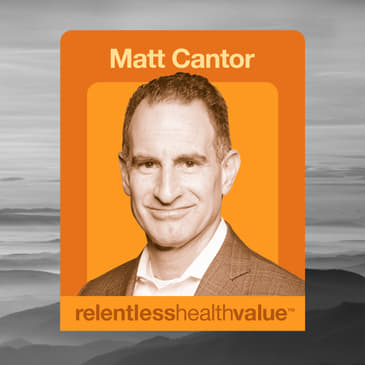
Hello, all you Relentless Tribe members. This is the third episode in our legal goings-on trifecta, starting with Doug Aldeen in episode 512 covering what amounts to the main reasons plan sponsors wind up suing their brokers or employee benefit consultants.
For a full transcript of this episode, click here.
If you enjoy this podcast, be sure to subscribe to the free weekly newsletter to be a member of the Relentless Tribe.
In our last episode (this was last week), that one was very, very much a prelude to this episode this week with Matt Cantor. I'm talking about episode 513 with Brennan Bilberry, where we broke down the cunning anticompetitive contracts that many consolidated health systems may choose to use to lock up local geographies.
And that local part is really important. Do not underestimate it, because healthcare is local, as we have heard so many times on the show. And that knowledge that healthcare is local can be used as an opportunity for patient-first endeavors, for sure; but it also can be used as a lever to maximize profits.
So, with Brennan last week—and if you didn't listen, do go back after this show and take a listen would be my recommendation—but last week, Brennan and I talked about the all-or-nothing clauses and the anti-steering and anti-tiering provisions that prevent plan sponsors from guiding their members to higher-quality, low-cost care.
And if you're thinking about all-or-nothing and anti-steering, anti-tiering, anticompetitive contracts, you might be remembering the episode with Cora Opsahl (EP452), where she gets into somehow the 32BJ union was subject to an anticompetitive contract that they didn't sign. 32BJ, the union that Cora worked for at the time, had to fight to give a low-cost maternity option to their members. And while they succeeded, most plans (let's get real) probably would not have.
It is insane if you think about it (and do go back and listen to that show) the amount of power some random hospital in the area wielded over a union who wanted nothing to do with them.
I say all this to say that today we are looking at what happens when someone finally says enough is enough and drags the 800-pound health system gorilla into court to answer for these exact types of contracting practices.

Before we start, though, quick level set: As has been demonstrated quite crisply and probably almost every single Relentless Health Value episode, the healthcare sector is, in so many ways, just one big market failure. One local market at a time in this country.
The point being, when health plan premiums skyrocket, everyone's first instinct is to blame the carrier. And fair enough, right? They're up to their own FTC and DOJ violations.
But also 80% to 85% of premiums are directly made up of underlying medical costs, and usually about 50% of those underlying medical costs are hospital charges. They are a plan paying for members who have visited a health system, and those hospital and health system prices are being driven up, in fact, by the corporate interests of these giant hospital systems operating in local geographies where they face little or no competition and/or pricing pressure.
It's just so sad when the leadership of these esteemed entities loses themselves at the level which some have. And, by the way, for a real deep dive on what I just said, go back and listen to the episode with Vivian Ho, PhD (EP466).
But yet holding these large, consolidated corporatized health systems accountable is incredibly difficult for many reasons; but a really, really big one is the halo effect. As Matt Cantor, my guest today, again points out, doctors and nurses and others who work at hospitals save lives.
Now there is a reason why, as Komal Bajaj, MD, said in the episode with her (EP458), there is a reason why almost half of those who work at a hospital don't trust their leadership to do right by themselves or by patients.
But when you go to court, it is very, very hard for a judge or a jury to separate the amazing doctors and nurses working on the floor from the corporate administration up in the C-suite that is utilizing market power to extract maximum revenue from a local community and often doing it tax-free.
Speaking of tax-free, add to all of this the fact that the FTC does not have jurisdiction over "nonprofits," and your primary witnesses—here's another problem—your primary witnesses usually against the hospitals are often, I dare say, extremely unsympathetic insurance executives or former executives, right? There is a steep uphill battle by almost any estimation.
But today, we talk about how that needle was threaded.
My guest today, Matthew Cantor, is an antitrust lawyer who was the lead trial and appellate counselor for the class in the landmark antitrust case against the Sutter Health System in Northern California.
After 13 years of litigation, three trips to the Ninth Circuit Court of Appeals, and right before the opening statements in a retrial, Matt and his team secured a $228.5 million settlement.
Why does this matter so much to self-insured employers and plan sponsors? Because this case established a groundbreaking precedent. Matt's team proved that the indirect purchasers, meaning everyday people and also the employers actually paying the inflated premiums, these indirect purchasers can recover damages from these hospital overcharges.
This is a new frontier. The DOJ is already picking up what this case put down, pursuing similar anti-steering litigation against health systems like Ohio Health and NewYork-Presbyterian. But the real opportunity may lie, as it often does, with self-insured employers. We've been saying this for years, but yeah … here we are.
There is so much latent potential here, which is also called the Sleeping Giant of self-insured employers. Which I will be talking about later on with Suhas Gondi, MD, MBA, when he makes a return appearance on the show in a month or so.
But yeah, if any self-insured employer is tired of being a passive price taker, which is the term used by Patrick Nelli in episode 509, this episode shows that litigation and/or maybe, I don't know, the threat of litigation is a viable possibility to keep providers with market power in check.
This episode is packed with so many aha moments, just … yeah, you're gonna love it.
But before we get there, I do need to thank some amazing folks who help keep this show on the air by providing some financial support, even though some of us over here are not getting paid, it is crazy how all of the out-of-pocket expenses add up.
So, I am very thankful, and maybe you are, too, if you listen to the show on the regular. I am very thankful to, first of all, Kimberly Carleson. Kimberly has covered our costs for our podcast editing software for the entire year in 2026. Thank you so much, Kimberly Carleson.
Wanna thank also Marilyn Bartlett. Marilyn has been a longtime supporter of Relentless Health Value, and she has been covering the cost for Adobe Creative Suite licenses for 2026 for our team, which we use for design and episode mixing. Thank you so much to Marilyn Bartlett.
Next, I'd like to thank Matt McQuide. Matt's contribution monthly has been covering the hosting and distribution of our podcast episodes. Thank you so much, Matt McQuide.
Next, let me thank Dr. Vivian Ho. Dr. Ho has contributed to cover the 2026 costs for our newsletter provider. Thank you so much.
Also on my list here to thank is Doug Geinzer. Doug paid for our audio engineer for a full month. Thank you so much to Doug Geinzer.
And then lastly, we have the trio Scott Conard, MD; Mike Tuggy, MD, FAAFP; and Larry Bauer, MSW, MEd. One of our newest recurring contributions is also helping to cover the cost of our audio engineer on a monthly basis.
Thank you so much to these individuals who help keep our show on the air. We'll have some more that I am looking forward to thanking next week.
This podcast is also sponsored by Aventria Health Group, who is our founding underwriter.
Also mentioned in this episode are Doug Aldeen; Brennan Bilberry; Cora Opsahl; 32BJ; Payerset; Vivian Ho, PhD; Komal Bajaj, MD; Suhas Gondi, MD, MBA; Patrick Nelli; Kimberly Carleson; Aventria Health Group; Shinder Cantor Lerner LLP; Monica Lypson, MD, MHPE; Daron Pitts; Thomas Frangione; Ivana Krajcinovic, PhD; and Elizabeth Mitchell.
For a list of healthcare industry acronyms and terms that may be unfamiliar to you, click here.
You can learn more at scl-llp.com and by following Matt on LinkedIn.
Matthew Cantor, JD, is a founding partner of Shinder Cantor Lerner LLP, an antitrust law firm that specializes in healthcare matters, based in New York and Washington, DC. Matt has over 30 years of experience litigating substantial, multibillion-dollar antitrust litigations. He has led a number of trial teams and argued multiple times in the appellate courts. He was lead trial and appellate counsel for the Certified Class of employers and individuals in Sidibe v. Sutter Health, an antitrust case that concerns claims that Sutter imposed anti-steering clauses and all-or-nothing contracting on health plans that resulted in Class members paying higher health insurance premiums. The Sutter Health case resulted in a $228.5 million settlement for the Class. Matt has a JD from the New York University School of Law and a BA from the University of Michigan.
00:00 Introduction to this episode.
04:26 Why does the halo effect make it difficult to hold hospitals accountable?
04:46 EP458 with Komal Bajaj, MD.
06:16 Why the case around this episode matters.
09:31 The conversation with Matt Cantor.
09:36 The brief background of how we got here.
10:55 The Sutter litigation: an overview.
12:57 Local geography versus local market.
14:51 EP466 with Vivian Ho, PhD.
17:50 Why litigation?
18:00 EP513 with Brennan Bilberry.
23:50 Why are these cases so difficult?
26:08 LinkedIn post by Kimberly Carleson on the Blue Cross Blue Shield settlement.
26:13 Comment by Daron Pitts on Kimberly Carleson's LinkedIn post.
26:32 Comment by Thomas Frangione on Kimberly Carleson's LinkedIn post.
27:36 What Matt Cantor thinks will be the future of litigation against these hospital systems.
28:11 Why Sutter?
31:21 What led to the ultimate victory in the Sutter case.
33:05 EP501 with Ivana Krajcinovic, PhD.
35:42 EP436 and EP491 with Elizabeth Mitchell.
37:35 EP509 with Patrick Nelli.
37:52 What is possible for employers now?
40:54 Antitrust enforcers that employers should consider.
41:49 The greatest challenge in fighting healthcare costs and medical spend.
Recent past interviews:
Click a guest's name for their latest RHV episode!
Brennan Bilberry, Doug Aldeen, Dr Siva and Dr Monica Lypson, Betsy Seals, Patrick Nelli, Lee Lewis, Stacey Richter with 15 experts (EP507), Jerry DiMaso
[00:00:00] Episode 514 Successfully Suing a Health System for Their Anticompetitive Contracts and Also Collecting Damages for Plan Sponsors and Members. Today, I speak with Lead Litigator Matt Cantor.
[00:00:24] American healthcare entrepreneurs and executives you want to know. Talking. Relentlessly Seeking Value. Hello, all you Relentless Tribe members. This is the third episode in our legal goings on trifecta, starting with Doug Aldeen in Episode 512 covering what amounts to the main reasons plan sponsors wind up suing their brokers or employee benefit consultants.
[00:00:52] American healthcare professionals in our last episode. This was last week. That one was very, very much a prelude to this episode this week with Matt Cantor. I'm talking about Episode 513 with Brennan Bilberry, where we broke down the cunning anti-competitive contracts that many consolidated health systems may choose to use to lock up local geographies.
[00:01:19] And that local part is really important. Do not underestimate it because healthcare is local, as we have heard so many times on this show. And that knowledge that healthcare is local can be used as an opportunity for patient-first endeavors, for sure. But it also can be used as a lever to maximize profits. So, with Brennan, and if you didn't listen to go back after this show and take a listen would be my recommendation.
[00:01:48] But last week, Brennan and I talked about the all-or-nothing clauses and the anti-steering and anti-tiering provisions that prevent plan sponsors from guiding their members to higher quality, low-cost care.
[00:02:02] And if you're thinking about all-or-or-nothing and anti-steering and anti-tiering, anti-competitive contracts, you might be remembering the episode with Cora Upsall, link in the show notes, where she gets into somehow the 32BJ union was subject to an anti-competitive contract that they didn't sign.
[00:02:23] 32BJ, the union that Cora worked for at the time, had to fight to give a low-cost maternity option to their members. And while they succeeded, most plans, let's get real, probably would not have. It is insane if you think about it and do go back and listen to that show, the amount of power some random hospital in the area wielded over a union who wanted nothing to do with them.
[00:02:49] I say all this to say that today we are looking at what happens when someone finally says enough is enough and drags the 800-pound health system gorilla into court to answer for these exact types of contracting practices. Before we start, though, quick level set, as has been demonstrated quite crisply in probably almost every single Relentless Health Value episode, the healthcare sector is in so many ways just one big market failure.
[00:03:20] One local market at a time in this country. The point being, when health plan premiums skyrocket, everyone's first instinct is to blame the carrier. And fair enough, right? They're up to their own FTC and DOJ violations. But also, 80 to 85 percent of premiums are directly made up of underlying medical costs.
[00:03:44] And usually about 50 percent of those underlying medical costs are hospital charges. They are a plan paying for members who have visited a health system. And those hospital and health system prices are being driven up, in fact, by the corporate interests of these giant hospital systems operating in local geographies where they face little or no competition and or pricing pressure.
[00:04:11] It's just so sad when the leadership of these esteemed entities loses themselves at the level which some have. And by the way, for a real deep dive on what I just said, go back and listen to the episode with Dr. Vivian Ho. But yet, holding these large, consolidated, corporatized health systems accountable is incredibly difficult for many reasons. But a really, really big one is the halo effect.
[00:04:37] As Matt Cantor, my guest today again, points out, doctors and nurses and others who work at hospitals save lives. Now, there is a reason why, as Dr. Komal Bajaj said in the episode with her, there is a reason why almost half of those who work at a hospital don't trust their leadership to do right by themselves or by patients.
[00:05:01] But when you go to court, it is very, very hard for a judge or a jury to separate the amazing doctors and nurses working on the floor from the corporate administration up in the C-suite that is utilizing market power to extract maximum revenue from a local community. And often doing it tax free. Speaking of tax free. Add to all of this, the fact that the FTC does not have jurisdiction over in air quotes, nonprofits and your primary witnesses.
[00:05:30] Here's another problem. Your primary witnesses usually against the hospitals are often, I dare say, extremely unsympathetic insurance executives or former executives. Right. There is a steep uphill battle by almost any estimation. But today we talk about how that needle was threaded. My guest today, Matt Cantor, is an antitrust lawyer who was the lead trial and appellate counselor for the class in the landmark antitrust case against the Sutter Health System in Northern California.
[00:06:00] After 13 years of litigation, three trips to the Ninth Circuit Court of Appeals and right before the opening statements in a retrial, Matt and his team secured a 228.5 million dollar settlement. Why does this matter so much to self-insured employers and plan sponsors? Because this case established a groundbreaking precedent.
[00:06:25] Matt's team proved that the indirect purchasers, meaning everyday people, and also the employers actually paying the inflated premiums, these indirect purchasers can recover damages from these hospital overcharges. This is a new frontier. The DOJ is already picking up what this case put down, pursuing similar anti-steering litigation against health systems like Ohio Health and New York Presbyterian.
[00:06:52] But the real opportunity may lie, as it often does, with self-insured employers. We've been saying this for years. But yeah, here we are. There is so much latent potential here, which is also called the sleeping giant of self-insured employers, which I will be talking about later on with Dr. Suhas Gandhi when he makes a return appearance on the show in a month or so.
[00:07:13] But yeah, if any self-insured employer is tired of being a passive price taker, which is the term used by Patrick Nelly in episode 509, this episode shows that litigation and or maybe, I don't know, the threat of litigation is a viable possibility to keep providers with market power in check. This episode is packed with so many aha moments. Just, yeah, you're going to love it.
[00:07:41] But before we get there, I do need to thank some amazing folks who help keep this show on the air by providing some financial support, even though some of us over here are not getting paid. It is crazy how all of the out-of-pocket expenses add up. So I am very thankful, and maybe you are too, if you listen to the show on the regular. I am very thankful too. First of all, Kimberly Carlson.
[00:08:05] Kimberly has covered our costs for our podcast editing software for the entire year in 2026. Thank you so much, Kimberly Carlson. Want to thank also Marilyn Bartlett. Marilyn has been a longtime supporter of Relentless Health Value, and she has been covering the costs for Adobe Creative Suite licenses for 2026 for our team, which we use for design and episode mixing. Thank you so much to Marilyn Bartlett. Next, I'd like to thank Matt McQuide.
[00:08:33] Matt's contribution monthly has been covering the hosting and distribution of our podcast episodes. Thank you so much, Matt McQuide. Next, let me thank Dr. Vivian Ho. Dr. Ho has contributed to cover the 2026 costs for our newsletter provider. Thank you so much. Also on my list here to thank is Doug Gainzer. Doug paid for our audio engineer for a full month. Thank you so much to Doug Gainzer.
[00:08:59] And then lastly, we have the trio, Dr. Scott Connard, Dr. Mike Tuggey, and Larry Bauer. One of our newest recurring contributions is also helping to cover the costs of our audio engineer on a monthly basis. Thank you so much to these individuals who help keep our show on the air. We'll have some more that I am looking forward to thanking next week. This podcast is also sponsored by Aventria Health Group, who is our founding underwriter.
[00:09:26] My name is Stacey Richter, and here is my conversation with Matt Cantor. Matt Cantor, welcome to Relentless Health Value. Thanks. Thanks for having me. Do you want to just give a brief background of how we came to this moment here? So I'm an antitrust lawyer, and I've become very interested in the intersection between healthcare and antitrust enforcement.
[00:09:49] There's an idea that it should be defined by competition in accordance with our capitalistic principles. But the reality is that many, many healthcare markets do not evidence competition. They show market failure, meaning that they're dominated by a particular monopolist or by a couple of entities that have substantial market power.
[00:10:11] And what that means is that from a pricing and quality perspective, they are private actors that are able to raise prices over what they would be able to charge in a competitive environment. And that, at the end of the day, hurts Joe American and Josephine American. And that's the problem that we have in this country. And so far, there's been very little political will to deal with it. So antitrust enforcement is a tool, although it's a narrow tool.
[00:10:40] It's a tool that we have to try to keep prices down. You use the term private actors. Some of these entities are, in fact, and I'm using the air quotes here, nonprofits. We're talking about prices going as high as possible. And this whole conversation today is going to be about the litigation that you pursued with Sutter that is also a nonprofit. The spirit of the endeavor here, you're kind of saying maybe a little bit off the table.
[00:11:10] Well, yeah, let me look. So let me talk about a couple of the things that you just said. You mentioned the Sutter litigation. So, you know, I am a partner at a firm called Schindler Cantor Lerner. I used to be a partner at another firm. And during the last 12 years, we prosecuted a case on behalf of a class of employers and individuals that paid premiums in Northern California for health insurance.
[00:11:35] And the claims in that case were that the health insurance premiums that they paid were higher than they otherwise would have been because Sutter was exercising substantial market power over insurers. Sutter, we argued, was the 800-pound gorilla in Northern California, given all of its hospitals and certain contractual clauses.
[00:11:56] With respect to your issue about not-for-profit, so, you know, one of the defenses in the Sutter case, Sutter would say, well, we're a not-for-profit entity. Sutter made $12 to $13 billion a year in revenue, made hundreds of millions of dollars a year as it reports in its financial statements and net income. Paid its executives in many, many millions of dollars.
[00:12:23] So, when we say not-for-profit, we're not talking about a charity here. We're talking about a big business. In fact, its former CFO testified that it was a major business. All that not-for-profit means in that scenario is that the entity, the hospital, doesn't pay taxes, doesn't pay income taxes. That's it. But it's not that it's not a big business. And Sutter tried to use that not-for-profit moniker, if you will, to try to suggest that it was a benign entity.
[00:12:53] But in my view, at least, it didn't prevail in that sense. So, you're using the term local geography, not local market. Right. I know why I would make that distinction, but why are you making that distinction? Well, what a market is in antitrust is as two factors. One is, what is the effective area of competition? And what is the effective product that's being offered? So, it's a bit of a charged term in antitrust.
[00:13:21] But from a standpoint of geography, yes, there's no question that the consumption of healthcare in this country is done on a local basis. And because of that, you have hospitals in certain areas that are dominating, that have market power. And that might sound weird, right?
[00:13:38] In our case, we basically argued, and I think the evidence showed, that Sutter was forcing United Healthcare, big, bad United Healthcare, this national insurer, into various different contractual arrangements. And you might say, well, how could that be so? Well, the reason is because in the various different markets that make up Northern California, Sutter has market power.
[00:14:02] And if United Healthcare doesn't contract with Sutter, it won't have a network that's substantial enough to be able to offer as a form of insurance. So, it's very important to understand about how localized the consumption of healthcare is in the United States. Many of our listeners are going to be familiar with the idea of network adequacy, that if Sutter, in this particular geography, and this is true in many areas across the country,
[00:14:30] if you have a dominant healthcare system that consolidated it, bought up private practices or other hospitals, the insurer would have to pretty much exit that area if they were going to insure anyone or provide ASO services for anyone in that particular area. One of the things that we talk about, and Vivian Ho last year talked about this as well,
[00:14:54] we often forget that if you look across all the hospitals in this country, they actually have a greater share of margin, if we're talking about nonprofits, than, for example, all of the insurers in the country. Then it kind of becomes, and I think you were alluding to this, as you said, just because you're nonprofit doesn't mean you're a benign entity.
[00:15:16] I think that's a really interesting way to put it in the sense that you have clinicians, you've got doctors and nurses who are really helping people. You have these entities that have, and individuals who work there should have a halo. But then at the same time, these are corporatized entities if you're looking at what their leadership is doing. They are incentivized on, in air quotes, growth. They are incentivized on how much gross revenue they can pull in.
[00:15:46] And there's just a dichotomy between what is going on upstairs versus what is going on on the floors and with the individuals that are dealing with patients. And I can imagine that in your line of work, that becomes material just relative to the perception of what's happening here. It's very, very important.
[00:16:09] It's very important for these litigations or the litigation that certainly we prosecuted against Sutter and some other litigations that were involved in. Because as you said, Sutter and all hospitals do wonderful work. No one wants to say that these hospitals are not helping Americans. Of course they are. If you're sick, you're going to the hospital and you want the best doctors and the best nurses possible. These cases have never been about the doctors or the nurses. It's about the administrations of these entities.
[00:16:38] It's about the, as you said, the sort of corporate entity that these entities have. And, you know, again, when they say, well, we're not for profit, what they're basically trying to say is at the end of the day, we don't have shareholders. But if you're taking your profit and providing it in the form of executive salaries and bonuses and pension plans, and you're taking that from higher prices, you know, that's effectively a form of taking from Peter and giving it to Paul or taking from Paul and giving it to Peter.
[00:17:07] So that's a significant issue. At the end of the day, what all this adds up to, there was a class of individuals who claimed their premiums and the prices and their out-of-pocket spend was way higher because of all of what we just talked about. That this wasn't some kind of just innocent, hey, we're going to do stuff and it really doesn't affect citizens.
[00:17:34] The claim was, and we say this a lot, financial toxicity is clinical toxicity. Financials are, in fact, a clinical risk factor here. And that was afoot. Like, that was what the plaintiffs were saying. What my question is, before we start talking about this litigation, is why litigation in the first place? And let me just run through what I'm thinking here.
[00:18:00] First of all, the Federal Trade Commission does not have jurisdiction over nonprofits. And we talked about this in the Brendan Bilberry show. Nobody really thought that, in air quotes, nonprofits were going to go into the profit maximizing business that we just were talking about. But aren't there regulations? How did we get into the, we got to litigate this zone?
[00:18:25] Isn't somebody in charge of making sure that if you're saying that you're a nonprofit, that you are, in fact, acting in the spirit of the endeavor? Well, first of all, it's true the Federal Trade Commission does not have jurisdiction over nonprofits. But the United States Department of Justice does, the antitrust division. So often, when we're talking about business behaviors engaged in by a not-for-profit entity that may be anti-competitive, that the antitrust division can sue over them. But what you say is really important. So why litigation?
[00:18:55] Because litigation is expensive. And litigation takes a long time. My God, the Sutter case took 13 years until we finally reached a $228 million settlement on behalf of the class. We went through an entire month-long trial, went to the Ninth Circuit Court of Appeals three times, reversed the judge twice. The Ninth Circuit identifies various evidence and admissions that substantiated our claims. And when we were about to open for a second antitrust trial, that's when we reached a settlement. Why litigation, though?
[00:19:24] Well, because, again, in our country, we do not have any type of systemic regulatory scheme that governs how health care is to be delivered and particularly pricing. There is when it comes to Medicare. That's certainly a public option if you reach a certain age. Or Medicaid. But for the majority of Americans, there's not. So what does that mean? Well, it means that when you go to the hospital, your insurance company is going to be charged for that or your employer if it's a self-insured entity.
[00:19:54] And at the end of the day, well, what does that mean for you? Do you think you're not paying the costs of a higher-priced MRI or a higher-priced knee replacement? But you are. Every time there's a higher-priced MRI, premiums are going to go up. And those premiums are going to go up, by the way, not only based on the medical care that you choose, but the medical care that other people in the insurance plan choose. So you're paying more money.
[00:20:19] This creates a real problem, a real transparency problem, because most people do not appreciate when medical expenses are going up like they do, for example, when gas at the pump is going up. Yeah, and the way that we say it quite a bit on this podcast is that premiums are set based on underlying prices. We have the MLR, the medical loss ratio, which stipulates that if those underlying prices go up, then premiums will go up accordingly.
[00:20:46] I think the point that you're making is commercially purchased plans are price takers, especially if in a local geography there is a consolidated health system. They can raise prices and they are what they are.
[00:21:00] It sounds like what was happening was there was no choice other than to litigate because you had this class of individuals who legit, legally had a valid complaint that their prices were going up and up and up based on this anti-competitive behavior. It doesn't sound like anybody else who had the wherewithal was doing anything, therefore litigation.
[00:21:29] Is that how we got there? Like you're kind of the end of the road? I think that's right. There's two things I want to add to that, though. When you say no one else, I will say the California attorney general did investigate Sutter and ultimately became a plaintiff in a state court litigation after we sued with another group of self-insured entities.
[00:21:46] So the California attorney general certainly had pushed Sutter and was able to effectively constrain Sutter's behavior by getting some injunctive relief in its proceeding with the self-insured entity. So I give kudos to the California AG. But the California AG was not going to recover sums for people who paid them.
[00:22:09] And that's where our litigation was somewhat innovative because we were able to recover on behalf of people who paid these insurance premiums that are higher than they otherwise should have been. That had never happened before. There had never been a class certified. It's called an indirect purchaser class. An indirect purchaser class and an antitrust dispute concerning provider market power or the exercise of provider market power. This really was the first one.
[00:22:38] And so we take enormous pride in the accomplishment that we had there, not only in certifying the class, but when we went up to the appellate court said, this looks good. I'm not even going to review it. And when you talk about an indirect purchaser class, you're meaning there were individuals who were paying premiums to an insurer that ultimately wound up paying the hospital's prices. Is that what you mean?
[00:23:02] In the scenario that we had, the direct purchasers of the services or the direct payers were the insurance companies. The employers and individuals that paid premiums to the insurance companies were the indirect purchasers of Sutter services. So, for example, our class included certainly Joe Californian and Josephine Californian, but it also included the University of California because the University of California was an employer that paid premiums on behalf of its employees.
[00:23:32] You know, right now we have 50 percent of most plan sponsors spend going toward hospital charges. This is billions and billions of dollars across the country. And I can only imagine what it was in North California for these entities to lawyer up. But I can also see why these cases would be so difficult, because as we were talking about before, you've got the halo effect.
[00:23:55] I mean, there are fund drives that some of these entities have where they're collecting change in the grocery store while at the same time, as you're talking about, you have the palatial C-suites. There's a Einstein quote that Monica, Dr. Monica Lipson reminded me of the other day. A sign of intelligence is being able to hold two contradictory ideas in your head simultaneously. And we sort of have that here.
[00:24:24] And I could see how that would be difficult. Additionally, I don't know, maybe the witnesses are somewhat unsympathetic if you've got carriers that are involved in this mix. Like, oh, no, a carrier is getting screwed. But yeah, you had a lot of headwinds here, not least of which is the first case of its kind. Yeah. So I think those are really good points. I mean, this was a jury proceeding.
[00:24:51] So you have to convince people who aren't economists, aren't lawyers, aren't health care experts about the fact that this is a broken system and that people were taken advantage of. Many of our witnesses were employees and former employees of large insurance companies that were trying to create innovative low-priced products, but they were from large insurance companies.
[00:25:15] The reality in this country, as we know, is that there's a lot of anger out there with respect to certain health care companies. I will tell you that I had another proceeding in federal court here in New York where a benefit manager that represents insurance companies was the defendant. The jury ended up awarding us more money than we even asked for. There was so much anger towards the insurers.
[00:25:41] So having them as your witnesses, even if they're telling the truth, it comes with some skepticism. We, of course, have the $2.67 billion recent antitrust settlement against BCBS where they were accused of, yeah, very similar stuff, you know, inflating premiums and limiting choice for consumers and employers. Those two, chestnuts.
[00:26:08] I'll link to a post by Kimberly Carlson on this settlement. Read the comments too. Like, for example, Darren Pitts makes the point about the power of dominating a local geography. Exactly what Matt Cancer is talking about. Darren writes, it's an industry-wide go-to strategy because, yeah, that's how you do it. You dominate as many local geographies as you can. Health care is local. And another comment, Thomas Frangione, hope I said your name right,
[00:26:36] wonders if the plaintiffs will ever get paid. So, yeah, there's also that. One of the things that I think we may start seeing, though, large employers, it used to be, well, antitrust, large companies wouldn't use it as a plaintiff idea. That's become less and less so. So, for example, we just represented over 60 employers, some of them very large.
[00:27:02] Amazon, Lowe's Hardware, The Gap, Starbucks, in proceedings against Visa and MasterCard over fees that they were paying to Visa and MasterCard and their banks. They thought they were being taken advantage of and that there was an antitrust action that was meritorious. Here, what we're seeing when it comes to employers are particularly self-funded entities is they're picking up more and more of the health care spend.
[00:27:27] You mentioned before 50% of their health care spend could be going to large providers now. And they're not negotiating these prices. And that can be very frustrating. I think that in the future, you're going to start seeing some of these large businesses be the key plaintiffs. And I think that might make it more challenging for the defenses of these hospital systems.
[00:27:49] By the way, I was just speaking with Dr. Vivian Ho a few weeks ago, and she and her team are currently working on a study that intends to show how much hospital consolidation in local markets drives up the cost of premiums. So look out for that. A lot of large employers listen to this podcast, and I'm sure wheels are turning. Why Sutter, though?
[00:28:13] You know, like if we look across the country, there are any number of instances where you have a local geography that has health systems that have consolidated to the extent that they are one of the very few games in town. And the same situation applies that if an employer wants to exist in that geography, then they will have to be either a price taker.
[00:28:40] There's not a market in the economic sense of the word. Was there something in particular where, as you were contemplating, do I take this case or do I not take this case relative to what was going on in Northern California that gave you a sense that this was possible to win just given all of the headwinds that we just talked about? Well, I want everyone to know that I have a lot of respect for Sutter and a lot of respect for their lawyers.
[00:29:08] I think that Sutter does a lot of things well. I think Sutter, at the end of the day, took a maximalist position in some of the things that it did and didn't really account for the fact that a good deal of these things were really anti-competitive and that it would have to pay out on it. And I think now, because of the publicity, the publicity related to the Sutter litigations, there was a 60-minute piece concerning the self-insured entity in California Attorney General case.
[00:29:38] There's been a lot written about our case. There's been a Ninth Circuit opinion now, which is one of the key opinions when it comes to trials and evidence in healthcare disputes and particularly in antitrust disputes. I think because of all this publicity, some hospitals are now taking note and saying, okay, we have to consider this as a real potential effect. We could be held accountable and liable if we're not given more credence to the antitrust laws and how they can affect our business.
[00:30:06] So I think that's really been a benefit of the litigation, but I'm not going to stand here and say that Sutter is the evil empire. I don't think they are. I think that they made some business decisions that I disagreed with and really hurt people, and I'm glad we were able to recover. But Sutter also wasn't the only entity that was thinking the way it did, and now I think there may be hopefully some kind of change with respect to at least some of these provider systems.
[00:30:31] At the same time, though, it sounds like what I just heard you say is that this particular hospital took what you're calling a maximalist position. They were thinking to themselves, I don't know, like who takes a maximalist, like either maybe strategically they were thinking that would be the best way to proceed or they're thinking they're a little bit untouchable.
[00:30:48] Right. I'm appreciating this conversation, and I think a lot of our listeners are going to be appreciating this conversation because this is a bit of a crack in anybody's illusion that potentially these entities are in fact untouchable and can do whatever they want because the halo will hold or any of the other factors.
[00:31:12] What do you think? And I'm putting myself into the position of a self-insured employer right now who's thinking to themselves, hmm, I could give you other examples. What was it about this case do you feel that led to the ultimate victory?
[00:31:28] Like were there very specific markers afoot that the jury ultimately, and I know it went back and forth several times, but that just led to the unequivocal result? This was an abuse of market power. Sure. What the evidence showed at the end of the day was that Sutter engaged in various different contractual practices that forced higher prices, right?
[00:31:54] And I know you talked about some of these practices with Brennan in your prior episodes, but it showed that first of all, Sutter required health insurers to contract with all of its systems, all of its hospitals, all of its physicians on a single all or nothing basis. You get all of its businesses, you get all of its hospitals, you get none of them, okay? And that was a really, really important issue.
[00:32:19] First of all, part of the older evidence that was excluded was that Sutter used to not contract in this way, and we were able to show with an economist that once it started doing that, the prices went up. So that's a big issue. And then Sutter was able to use this sort of all or nothing contracting to say to health plans, we're not going to allow you to steer your membership away from our high-priced hospitals to maybe lower-cost facilities that provide the same service at the same relative quality.
[00:32:48] And that was a big deal because Sutter was able to keep its prices high because that would quash competition, right? You weren't worried about the business leaving your facility that's at higher prices and going down to the facility that's lower priced down the road.
[00:33:04] And to hear about how preventing steering and tearing can cost a plan millions of extra dollars, listen to the episode with Ivana Krychinovich about how one hospital was charging a million dollars more for two patients who needed infusions.
[00:33:22] Can you imagine if that hospital charging a million dollars more prevented the plan from reaching out to those members and redirecting their care elsewhere to possibly an indie provider with just as high quality?
[00:33:36] You can see how this just kneecaps any plan in terms of not only using market forces, you know, supply and demand to figure out the fair price, but also when these anti-competitive clauses exist, there is just no mechanism to drive volume away from lower quality and maybe even unsafe clinicians.
[00:33:58] And speaking of unsafe clinicians, I was talking to a large employer recently who had identified 40 wildly unsafe physicians that cost this plan tens of millions of dollars in clearly avoidable charges for clearly avoidable issues in overtreatment. It wanted to kick these 40 physicians out of their network and the plan could not do it.
[00:34:25] They could not because of probably a bunch of things, but one of them certainly being anti-competitive contracts held by their ASO, probably with large consolidated health systems. So it was very, very different than a competitive scenario. So self-insured entities should know that if there are contracts out there that for their ASO networks, for their administrative services only network, prevent the building of narrow networks, well, then they can't give narrow network options to their employees.
[00:34:55] And they can't reduce their employees. And they can't reduce their spend. And by creating this higher spend, by having this higher spend, spend that's often going up more than the rate of healthcare inflation, which is higher than the rate of inflation, you have these employers that are paying a lot more money than they should in health insurance.
[00:35:21] And one last thing I just want to say, look, there's a reason why in this country we pay four times as much as they do in Japan and we live 10 years less. There's a reason. And it's because we have market failure over and over in market after market after market where providers can increase prices over the rate of inflation, over the competitive price.
[00:35:42] I want to bring up two shows with Elizabeth Mitchell where she talked about sometimes the most expensive care is the lowest quality care, irrespective of the price. If I'm thinking about this in terms of a large employer, for example, or I'm thinking about the opportunities as a result of this case and the precedent that it sets, what can happen now?
[00:36:06] So a couple of things with respect to providers, the first thing employers should do is they should consider where is their hospital spent. That's what they should do. And they should think about whether they're spending inordinate amount of monies at certain provider systems. Obviously, they can use that information to try to seek legislation. I know there's certain employer groups that are out there that are certainly pushing for more and more legislation.
[00:36:33] But if they can't, you know, again, there's an opportunity for litigation. There's lawyers out there that will do it, not just myself, but other firms as well. And we'll try to hold hospitals accountable. And this is not to say that, by the way, that I'm anti-hospital. I'm not anti-hospital at all. But there's no regulation in this country when it comes to prices.
[00:36:53] And I believe that the hospital industry, per se, has to come to a reckoning when it comes to affordability because it's just something that has gotten out of control. Healthcare inflation should not be happening the way it is. And employers have the ability to push back in terms of litigation as they have in other arenas. So that's a quiver they have in their portfolio.
[00:37:18] So if I'm thinking about this like a large employer or someone serving a large employer, most of our listenership knows the amount of their plan spend that goes into some of these consolidated health systems. We have medical trend going up. We had Patrick Nelly on the podcast saying it's going to be even in out year 7.7 plus percent going up.
[00:37:41] And a lot of that can be attributed to what is going on at the consolidated health system level and the amount of power that these corporatized entities at this juncture really have. So what is possible now? You had mentioned getting employers together or I guess depending on the size, going it alone, that it is possible to litigate. I mean, that has been shown to be successful.
[00:38:06] It's probably also possible to go into state legislatures or a legislature or a DOJ, DOL or any of the other bodies here and basically say, look, with this precedent, maybe you want to do something here. So I see four courses, right? One is try to get legislation passed. I think that that's going to be, at least at the federal level, exceedingly hard if you're talking about price regulation.
[00:38:34] Try to get state legislation, state legislators to do something. There is more possibility there in certain states, I think. You can rally enforcers. You know, the United States Department of Justice has recently filed cases against two systems on a Sutter-like theory. One is in Columbus, Ohio, the Ohio Health System, and the other is New York Presbyterian here in New York.
[00:38:59] It's possible that there are going to be additional type cases brought by this administration in that regard. And the last thing is litigation. Litigation is long. Litigation requires effort. You know, you have to produce documents. You have to put your employees up for depositions. Like, it's not something that you can do lightly. But if you prevail or you get to trial, you know, you're in a place where you have real negotiating leverage. And that's the benefit for litigation.
[00:39:28] So basically what you said, the first two were get federal legislation passed or get state legislation passed. Not only do we have the gridlock that we currently have, but we also have the amount of lobbying dollars that I think Stat News just wrote a huge article about. So there are certainly headwinds there. Then we get into the rally the enforcers. And you were talking about the DOJ. If we're talking about Arisa, you've got the DOL in the mix here.
[00:39:53] But given the result of this case and certainly some of the affordability issues and just the place that we are in the time-space continuum, making sure that if you're a large employer, you're talking to the enforcers potentially in your area of some of this potentially egregious behavior might not be a bad move. And then lastly, of course, we always have litigation.
[00:40:19] Also providers, you know, independent providers have a stake here. We have any number of you have this all or nothing or you have the steering and tearing or you have any of the other anti-competitive moves. Who is being excluded? There are also others who are trying to write if it's anti-competitive. There's some competitor who is being unfairly treated.
[00:40:42] So it may be that they're unfairly treated and it may be that they're just higher priced and they're less quality and that they shouldn't be part of the network. That's a fat question, I think. But you can have aggrieved providers. That's certainly true. One last thing I do want to say because you mentioned it and you're right and I omitted it. When I was talking about enforcers, I only mentioned the Justice Department or the FTC. Clearly, you should consider the state attorneys general.
[00:41:05] When it comes to antitrust now, and the California attorney general is a great example of this from the Sutter case, but when it comes to antitrust, the state AGs have really stepped up. There was recently a case not in the healthcare sphere. It's against Live Nation where the Justice Department, two weeks into the case, settled the case. The state AG said, we're not settling because we think these guys did really bad things and the settlement did not provide enough relief. And they ended up getting a jury verdict.
[00:41:34] So they really are at the forefront of antitrust litigation. So if you live in an area where you've got an active attorney general's office, particularly in the area of antitrust, they're clearly an option. Matt Cancer, is there anything that I neglected to ask you? I think the most important thing is to me that the greatest challenge that we have is educating people. And I'm understanding what they're paying for when they're paying insurance company premiums.
[00:42:01] And I'm not pulling the water for the insurance companies in this. Insurance companies many times do bad things and are also profit-driven and don't consider maybe the specifics of a particular human story. But I will say that it's very clear that premiums are predicated on this medical spend.
[00:42:22] And unless medical spend is reduced in this country, unless we only pay for necessary medical spend, only if we are paying prices that incentivize doctors to provide the services, we're going to collectively have a big problem. And we have a big problem. And that problem is going to expand and expand and expand. Maybe ultimately there will be a public option, but I think that's a long, long, long way off.
[00:42:49] Matt Cancer, if someone is interested in more information about the Sutter case or more about what you are working on, where would you direct them for more information? You can go to our website at www.scl-llp.com. My biography is there and, you know, it has my contact information. Just give me a shout. Matt Cantor, thank you so much for being on Relentless Health Value today. Thanks, Stacey. Appreciate it. Hi, I'm Dr. Vivian Ho.
[00:43:17] I'm a health economist at Rice University and Baylor College of Medicine. I listen to Relentless Health Value religiously because this is the show for those who are part of the tribe that wants to improve the quality of health care, improve access to care, and make it affordable. So make sure that you subscribe to the newsletter and subscribe to the podcast and keep up with every episode.