
This OG of directly contracted high-value networks or Centers of Excellence networks came up, name dropped and everything in the episode with Elizabeth Mitchell from PBGH, the Purchaser Business Group on Health, from two weeks ago. That was episode 491.
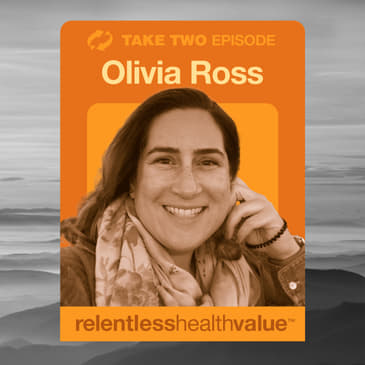
So, welcome to this deep cut episode with Olivia Ross from way back, pre-pandemic times.
For a full transcript of this episode, click here.
If you enjoy this podcast, be sure to subscribe to the free weekly newsletter to be a member of the Relentless Tribe.
This high-value network—its official name is the Employers Centers of Excellence Network, or ECEN—and it really came up in a meaningful way in that Elizabeth Mitchell episode, and it came up for two reasons.
(1) Because the work in that recent PBGH data demonstration project—and again, listen to the show with Elizabeth Mitchell for more on that if you didn't already—but here's the bottom line, whether you did or you didn't.
The PBGH demonstration project now gives plan sponsors like self-insured employers, with currently available transparency data and claims data, you can see the quality, price, and safety of any given service; and you can compare that price, quality, and safety with other hospitals.
Having this information enables any given self-insured employer or other plan sponsor to create a high-value network or Centers of Excellence network. They can do this all by themselves. They can create a high-value network all by themselves. So, there's that, and that is a really, really big sea change.
(2) ECEN was, again, as I just said, a direct contracted network.
And you know what Elizabeth Mitchell said during that recent show, episode 491? She said it's now confirmed that direct contracts between employers and clinical organizations perform way better than anything that most other third parties have negotiated.
I liked how Jeff Hogan summed this all up. It's a great post. But Jeff wrote, "Direct contracts have more measurable value than generic blunt instrument networks. Direct contracts serve the specific interests of the specific group. They also give unique care delivery organizations the opportunity to align their specific services with unique populations without the involvement of confiscatory middlemen."
And, yeah, this is really good news for all you unconfiscatory TPAs and others out there. This is really an opportunity to prove differentiation from those who enjoy the arbitrage maybe a little too lavishly.
And maybe lavishly is a really great word here, actually, because it's allegedly and apparently (as per more than one person who would certainly know) self-insured employers pay on average about 30% more in their claims wire for a service than whoever provided said service got paid. There's 30% added onto the top.

And look, I am certainly not saying that, you know, administrators shouldn't be paid or anything like that. Nobody should be working for free. The only problem here is when this 30% is not being disclosed, and it's often not. Brokers are in this arbitrage mix as well, of course—the not transparent ones, I mean, plus others.
I saw Andrew Tsang's graphic that showed 27 streams of payment coming out of the middle between plan sponsors paying and a clinician getting paid.
Okay … so, this directly contracted ECEN movie actually does have a sad ending, just FYI. The ECEN high-value network that we talked about in the pod that follows? It was ultimately dismantled.
Why was it dismantled? I don't know. It did happen right around the time that the independent and really capable TPA who was administering this whole thing and doing great member engagement also, this TPA was bought out by a larger firm. Maybe the timing was coincidental, though.
One last point before I roll tape. TPA obviously stands for third-party administrator. ASO stands for administrative services only.
I've been hearing more than once lately that the right way to proceed, in the future, is for employers to negotiate their own direct contracts for all the reasons that we just talked about with high-value clinical organizations. And then the TPA should just administer those contracts—administrative services only. Which is exactly what was going on in this ECEN. So, let the old be new again.
And all this is very good news, again, for great clinicians, great clinical organizations, and truly transparent TPAs and brokers who align themselves with the fiduciary responsibilities of their clients.
Themes that come up today include employers ganging up to get better prices on direct contracts. Cora Opsahl and Mark Cuban (EP488) talked about this some.
Olivia also in the show that follows, she gets kind of deep into how quality was assessed, just the depth of the value assessment that went on there. It actually went down to the physician level, and all this is really important ingredients here to really be able to select a center of excellence based on actual value.
Because as has been said multiple times by multiple people on the show, most carrier "high-value networks," when you actually look at who's included in those high-value networks, you look at their quality and their price, these places are not high value by most normal definitions of high value anyway. So, question mark.
One last thing besides my normal thank you to Aventria Health Group for sponsoring this episode, I am so pleased to thank Payerset for donating to help Relentless Health Value stay on the air.
Payerset is a price transparency company with a mission to democratize healthcare pricing. Love that. Payerset empowers healthcare organizations, payers, employers, and benefits coalitions with the most complete set of real market pricing data. They benchmark every negotiated rate and claim tracking reimbursement trends and delivering the actionable insights needed for smarter contract negotiations and a more transparent healthcare system.
Also mentioned in this episode are Transcarent; Elizabeth Mitchell; Purchaser Business Group on Health (PBGH); Jeff Hogan; Andrew Tsang; Mark Cuban; Cora Opsahl; Payerset; Matt McQuide; Christine Hale, MD, MBA; Eric Bricker, MD; The Leapfrog Group; National Quality Forum; Sam Flanders, MD; and Kada Health.
For a list of healthcare industry acronyms and terms that may be unfamiliar to you, click here.
You can learn more and follow Olivia on LinkedIn.
Olivia Ross, MBA, MPH, is senior director, product AI enablement, at Transcarent. Previously, Olivia led the development and implementation of the Employers Centers of Excellence Network (ECEN) for the Purchaser Business Group on Health.
07:40 Prospective bundles and the cost of care.
08:22 How the largest cost savings come from the improvements in quality.
09:51 What Olivia looks for in choosing centers of excellence.
10:36 Creating market pressure and avoiding consolidation.
11:17 Creating positive disruption in the healthcare system.
12:17 How Olivia chooses the centers and providers she works with in the Purchaser Business Group on Health.
13:12 The quality metrics Purchaser Business Group on Health looks at when assessing providers and centers.
14:04 What a team assessment is, and why it's important.
15:07 How local PCPs have to factor into this health care model.
17:57 How Purchaser Business Group on Health intervenes in the patient journey to ensure that the patient and the employer are getting the best quality care for the best price.
19:39 Olivia's suggestions on how to have an intervening conversation with a patient who has already been told he or she needs surgery.
20:18 EP468 with Matt McQuide.
20:20 EP471 with Christine Hale, MD, MBA.
20:22 EP472 with Eric Bricker, MD.
25:27 "Even at a more competitive price point, there's still an upside to them getting this new business."
25:52 How choosing specific physicians is part of the COE designation process.
27:35 How COEs and their physicians are also involved in continuous quality improvement.
30:56 Employers Centers of Excellence Network collaboration with The Leapfrog Group.
32:24 How the Employers Centers of Excellence Network program is open to any employer, no matter the size.
32:54 What it takes to join the Employers Centers of Excellence Network.
Recent past interviews:
Click a guest's name for their latest RHV episode!
John Quinn, Dr Sam Flanders and Shane Cerone (EP492), Elizabeth Mitchell (EP491), Shane Cerone and Dr Sam Flanders (Part 1), Dan Greenleaf (Part 2), Dan Greenleaf (Part 1), Mark Cuban and Cora Opsahl, Kevin Lyons (Part 2), Kevin Lyons (Part 1), Dr Stan Schwartz (EP486)