
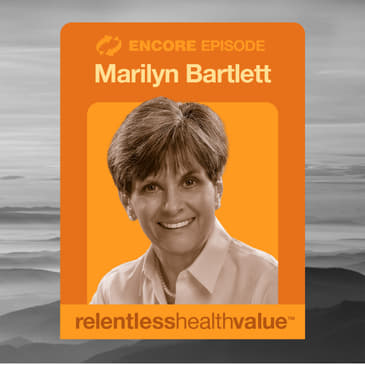
Marilyn Bartlett is the real deal. I saw Marilyn get a lifetime achievement award last year at RosettaFest from Dave Chase, and then I actually had the pleasure of getting up on the stage with her and heard that round of applause.
But it takes guts to push for fiscal discipline and put patients over profits. So, thank you so much to Marilyn for showing us how to get started fixing healthcare and for creating really true health value.
For a full transcript of this episode, click here.
If you enjoy this podcast, be sure to subscribe to the free weekly newsletter to be a member of the Relentless Tribe.
And that's why I'm encoring the show from last year. It's a great one. It's inspiring to revisit.
Plus, as just one more reason for this encore, I saw a post from Katy Talento on LinkedIn the other day; and it was about health system pricing transparency. But Katy referenced the NASHP (National Academy for State Health Policy) pricing tool, which is under Marilyn's leadership; and the NASHP tool can be used as a starting point for hospital negotiations.
We've had tons of shows about direct contracting, so this is really relevant. But I wanted to mention that version 5 of the NASHP tool will be out January 2026, so make a note to check it out.
And with that, here is my conversation with Marilyn Bartlett. Prepare to be inspired.
Yeah, I made a meme for the show with Marilyn Bartlett. My very first meme ever.
I picture that Olympic silver medalist shooter from Turkey who showed up in a T-shirt and his hand in his pocket versus the others with all their fancy equipment that, turns out, may or may not be necessary, regardless of who might swear up and down that complexity requires even more complexity and plenty of expensive gear to shoot straight. Point being, it's amazing what a dedicated CPA with a spreadsheet and their eye on the target can accomplish in the real world when they just do their thing and follow the dollar.

And with that, Marilyn Bartlett has entered the chat. Marilyn Bartlett isn't called the "Queen of Healthcare" for no good reason, and nobody is joking when they say this. She was probably the first person (or one of the first, at a minimum) to truly identify the amount of money getting sucked out of the wallets of taxpayers and employers and plan members and into the pockets of the healthcare and insurance and consulting industries.

Let's start from the beginning here. But you'll have to listen to the interview that follows for the end. And most of Marilyn's really sage advice and words of inspiration for any of you, for all of us, trying really hard to fix healthcare and, any day of the week, taking two steps forward and/or five steps back.
It's what Mike Tyson was talking about when he said, "Everybody has a plan until [you] get punched in the face." And yeah, I'd say pretty confidently that everyone in the Relentless Health Value tribe trying to fix healthcare has been there at some point or another.
So, here's where I begin the conversation with Marilyn Bartlett today: One day in 2014 or 2015, Marilyn was minding her own business as a CFO at a regional TPA (third-party administrator) firm about ready to retire when the state of Montana reached out. They asked if she would consider being the plan administrator for the state employee health plan, which was, turned out, headed for bankruptcy.
Marilyn took the job, and she took the state health plan from $9 million in the hole—they were in debt $9 million—to $112 million to the good. Well, meanwhile, plan members got better benefits. Think about that: $9 million in the hole to $112 million in the good. In fact, the plan had so much money in 2018 when Marilyn left that the state took some of it to pay for other things in the budget.
This is truly mind blowing. I mean, get a CPA with their eye on the ball, and this is the difference that is possible to be made in a state health plan. It also just needs to be said that this same state plan, the one that was going bankrupt, clearly had seen over $100 million of taxpayer money exit stage left and wind up in the bank account of their vendors.
Now might be a good time to mention something that Chris Deacon wrote about the Federal Employees Health Benefits Program. This is a $55 billion program, once again funded by taxpayers. As per an OIG (Office of the Inspector General) audit, there is no written policies or procedures over approval and payment of funds to the carriers via ACH (Automated Clearing House).
Wait, what? This is just one example along with a whole lot of other things that kind of make you go, "Hmmm … can a CPA with a spreadsheet please get in there and do your thing?"
In the conversation that follows, I ask Marilyn to tell me what she did in roughly three short years to do her thing and save the state of Montana over $100 million while improving benefits of the state workers.
And she tells me, short version, she created a why. That's step one. Step two, she looked at her spreadsheets and quantified the situation. She was able to identify a few big hairy problems, which she then hit fast and hard with solutions. This is gonna accomplish a couple of things if you do this, find a solution for a big enough problem.
First, it creates a quick win; and quick wins are needed to get some momentum to get started. Second, she knew that by solving big hairy problems, the solutions would have an outsized impact given the scope of these original problems. This is kind of Strategy 101.
And then step three, she dug in on assembling the right team with the right skills to make it through what amounts to a change management process, I'm gonna say.
What did Marilyn not do in those three years? She did not get captivated or sidetracked by any, I'm gonna call it, transformational theater—which is not easy because a lot of transformation theater has more glitter than a Las Vegas show and is really hard to look away from. It's as magical as most magical thinking.
Also, Marilyn stayed the course in the face of what I am sure were many opportunities for personal gain that would have not been a win-win for the state of Montana or its employees.
This episode is sponsored by Payerset and Aventria Health Group.
Payerset is a price transparency company with a mission to create fair and equitable healthcare for everyone. Love that.
Payerset empowers healthcare organizations, employers, and patients with the most complete set of healthcare price transparency data. They benchmark every negotiated rate and claim and deliver the insights needed for smarter contract negotiations and a more transparent healthcare system.
Also mentioned in this episode are Dave Chase; Katy Talento; Chris Deacon; Payerset; Aventria Health Group; Cora Opsahl; Claire Brockbank; Paul Holmes; Mark Cuban; Ferrin Williams, PharmD, MBA; and Shawn Gremminger.
For a list of healthcare industry acronyms and terms that may be unfamiliar to you, click here.
You can learn more by connecting with Marilyn on LinkedIn.
Marilyn Bartlett, CPA, CMA, CFM, CGMA, has focused on healthcare financial management, serving as Controller for a national health insurance carrier, as CFO for a regional health care third-party administrator, and in health management positions within the Montana State Government. As a consultant, she works with Patient Rights Advocate and various employers to "follow the money" in healthcare, with the goal of transparency and lower costs. As senior policy fellow for the National Academy for State Health Policy (NASHP), she developed the NASHP Hospital Cost Tool, using hospital-filed Medicare Cost Report data, focused on transparency of hospital financial performance.
As administrator of the State of Montana Employee Benefit Plan, she moved the plan from projected reserves of -$9 million to $112 million in less than three years. She disrupted the status quo by implementing reference-based pricing contracts with all Montana hospitals. For her work, she was recognized as #13 of the World's 50 Greatest Leaders in 2019.
07:09 What gave Marilyn the confidence to fix Montana's state health plan?
08:35 Why Marilyn knew she would have enough power to make the changes needed in Montana's state health plan.
09:35 What Marilyn achieved in her time as the administrator of the Montana State Employee Health Plan.
11:03 What were the "quick wins" Marilyn was able to achieve when she first took over as administrator?
17:55 EP453 with Claire Brockbank, which covers RFP in detail.
18:12 How Marilyn structured her plan for the Montana State Employee Health Plan.
21:42 What's the key to setting yourself up for success when doing what Marilyn was able to achieve?
25:23 Why putting together your own team is so important.
28:24 EP418 with Mark Cuban and Ferrin Williams, PharmD, MBA.
29:28 What happened when Marilyn left the Montana State Employee Health Plan?
31:28 Have the costs of the plan gone up since Marilyn's time working on it?
Recent past interviews:
Click a guest's name for their latest RHV episode!
Dr Mick Connors, Sarah Emond (EP494), Sarah Emond (Bonus Episode), Stacey Richter (INBW43), Olivia Ross (Take Two: EP240), John Quinn, Dr Sam Flanders and Shane Cerone (EP492), Elizabeth Mitchell (EP491), Shane Cerone and Dr Sam Flanders (Part 1)