
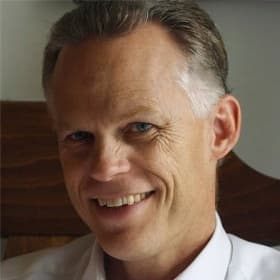
EP305: The 1% Most Expensive Claimants Racking Up Massive FFS Bills and Still Not Getting the Help They Need From Our Health Care System, With Darrell Moon, CEO of Orriant
January 14, 2021
305
32:49

EP305: The 1% Most Expensive Claimants Racking Up Massive FFS Bills and Still Not Getting the Help They Need From Our Health Care System, With Darrell Moon, CEO of Orriant

My guest in this health care podcast is Darrell Moon, who is the CEO over at Orriant.

I was super intrigued by some of the work that Darrell and his team are doing regarding high-cost claimants. Said a different and probably better way, certain people in need of care were identified because they were costing so much. Year after year after year, these individuals—I call them hyper-users during this episode, but it’s possible I made that term up myself—these hyper-users were getting all kinds of expensive health care, while at the same time, they were not getting any better.

So, Darrell and his team realized that something was afoot here, and it turned out to be a combination of maybe loneliness, maybe low self-esteem and low self-efficacy. And no matter how many times you go to the cardiologist or the rheumatologist or the pulmonologist, none of those things will be cured.

In fact, when someone’s identity becomes their myriad of health issues, they have a sort of perverse incentive, if you think about it, not to follow any of their doctor’s recommendations to take meds or make lifestyle changes. So, while their underlying condition—low self-esteem, low self-efficacy—remains untreated, their physical health tends to actually get worse, not better, despite all the medical attention. What’s necessary to help this type of patient is the best that behavioral science has to offer.

A nuance I found really interesting and important in the work that Darrell is doing is that it’s pretty easy to identify a hyper-user from someone with a horrid chronic condition simply requiring a lot of care. The hyper-users will respond and appreciate the extra attention that a behavioral health coach/program has to offer. In contrast, those with other ailments will just merely get annoyed—usually on the quick—so they exclude themselves from the program.

Sidebar: My guest Darrell Moon is organizing an Aspirational Healthcare Conference for July 14 and 15, 2021. In that virtual meeting, the intent will be to highlight Southcentral Foundation’s Nuka System of Care in Alaska and other similar health care models that achieve much better health care outcomes at half the cost. So, check that out if you are so inclined.

Thanks so much also to Lee Lewis from the HTA (Health Transformation Alliance) for the introduction to Darrell and Orriant.

You can learn more at orriant.com.

Darrell Moon founded Orriant in 1996 to change the dynamics of health care and give employers some control over the ever-increasing costs of the health care benefits they offer their employees. Darrell believed that engaging individuals in the management of their own health was a key that had to be inserted back into the economic equation of health care. Darrell received both his bachelor’s degree in finance and his master’s degree in healthcare administration from Brigham Young University. As the CEO, COO, or CFO, Darrell managed medical and psychiatric hospitals throughout the country for over 10 years prior to creating Orriant. He also has more than a decade of experience managing insurance and managed care products. Darrell is a Forbes leadership contributor.


03:11 What do CEOs want out of the health care system?
04:52 Is it a good strategy to focus on high-cost claimants?
07:04 Who are the people year over year that wind up in the high-cost claimant pool?
07:50 “Really, you have to get to the crux of the problem, which is … they’ve become a victim … to the health care system.”
08:16 Who are these “hyper-users” and how do we define them?
11:35 “Getting that person to have a regular relationship with someone isn’t the hard part; the hard part is then helping them to build their self-esteem.”
13:20 “That’s the key to building self-esteem—is helping people accomplish what’s most important to them.”
14:57 Why helping a patient not to view themselves as a victim helps them manage their care better.
17:45 “It’s often less the training and the right personality of the person.”
18:54 Do health outcomes correlate with the self-esteem of the patient?
19:28 “If you want to identify future claims, ask people two questions: 1) Tell me about your health … and 2) Tell me about your social experience.”
21:21 “They’re the customer/owner of their own health.”
24:23 “How do you help not just the 1% but everybody [in health care]?”
27:16 “The ideal environment is to have a massively powerful primary care team.”
27:47 “Having an influence on that person and what they do and how they behave is more important than getting the diagnosis right.”
29:34 “It’s not about just when [people] reach out … but [getting] people to reach out early.”

You can learn more at orriant.com.

healthcare,fee for service,healthcare costs,health tech,orriant,high-cost claimant,
|
|

Episode Support Provided By

Special Thanks to Our 2026 Sustaining Monthly Donors

Marilyn Bartlett, Kimberly Carleson, Dylan Yahn, Benjamin Light, Matt McQuide, Ann Kempski, Spencer Allen, Scott Tromanhauser, Steven Elkins, Matthew Bunte, Lori Smith, Dr. Scott Conard, Vivian Ho and Casey Cormier

Recent Episodes

EP537: Physicians as the Sleeping Giant—Why Many Doctors Don't Push Back and Some Advice, With Benjamin Schwartz, MD, MBA
Relentless Health ValueNovember 11, 2026
537
35:1932.33 MB

EP537: Physicians as the Sleeping Giant—Why Many Doctors Don't Push Back and Some Advice, With Benjamin Schwartz, MD, MBA

Listen on Your Favorite App Benjamin Schwartz, MD, MBA: You got to start kinda nudging the giant. And I think from the physician standpoint, that is … the simplest thing is just educate yourself, understand what's going on, take an interest in it, and that's how you start. And then you go from there...

EP536: Operationalizing the Architecture of Primary Care Patient Experience, With Rebecca Andrews, MD
Relentless Health ValueNovember 04, 2026
536
37:5134.64 MB

EP536: Operationalizing the Architecture of Primary Care Patient Experience, With Rebecca Andrews, MD

Listen On Your Favorite App Stacey: If you are a plan sponsor thinking about, for example, primary care as a way to optimize healthcare spend, do know that any given plan sponsor will really only get maximum possible benefit from an investment in primary care, advanced primary care, when and only wh...

EP535: When Patient Experience Means Parking and Pianos, Plan Sponsors Pay for Hotels, Not Outcomes—What to Measure Instead, With Robyn Leone
Relentless Health ValueOctober 28, 2026
535
37:1834.15 MB

EP535: When Patient Experience Means Parking and Pianos, Plan Sponsors Pay for Hotels, Not Outcomes—What to Measure Instead, With Robyn Leone

LIsten on Your Favorite App On episode 532 a few weeks ago, Chris Klomp from HHS was talking about ER (emergency room) usage as a signal, not just a statistic. If too many folks show up in the ER, consider this a signal that there's something missing. It means a patient who doesn't have access to pr...

EP534: The One Question to Test if a TPA Is Actually Independent, With Kimberly Carleson
Relentless Health ValueOctober 21, 202608:538.13 MB

EP534: The One Question to Test if a TPA Is Actually Independent, With Kimberly Carleson

Listen On Your Favorite App Here's a question I have heard more than once: What is a practical, speedy way to assess whether a TPA (third-party administrator) is truly independent and willing to protect the plan's interests, this plan sponsor's interests, versus being captive to, for example, networ...

EP533: Level Funding Is Self-funding: 5 Avoidable Contract Risks, With Frank Pennachio
Relentless Health ValueOctober 14, 2026
533
37:1334.07 MB

EP533: Level Funding Is Self-funding: 5 Avoidable Contract Risks, With Frank Pennachio

Hello, all you Relentless Tribe members. Thanks for hanging with me today to talk about a bunch of things. One of them being what exactly are level-funded plans, and what are the upsides, and then what are the risks? Because here's the thing. I was talking to an employer the other day, an employer w...

EP532: Why Avoidable ER Visits Aren't the Real Cost Problem: Revisiting Our 2016 Interview With HHS Nominee Chris Klomp
Relentless Health ValueOctober 07, 2026
532
37:2034.17 MB

EP532: Why Avoidable ER Visits Aren't the Real Cost Problem: Revisiting Our 2016 Interview With HHS Nominee Chris Klomp

Listen on Your Favorite App Today we are dipping into the archives for an essential replay from 2016, one decade ago, featuring Chris Klomp back when he served as CEO of a company called Collective Medical. With the nomination of Chris Klomp to serve as deputy secretary of the Department of Health a...

EP531: Slaying the Three-Headed Monster of Health Plan Networks, With Evan Anderson
Relentless Health ValueSeptember 30, 2026
531
38:0634.88 MB

EP531: Slaying the Three-Headed Monster of Health Plan Networks, With Evan Anderson

Listen on Your Favorite App Today, Evan Anderson and I are talking about carrier networks, how they started, how it's going. Because irrespective of whatever the plan was at the very beginning, any given network, especially talking about the big status quo networks, has evolved into what I'll call a...

Listen and Follow

Sponsored by Aventria Health Group
©2026 BD Bridges LLC. All Rights Reserved.